News Details
FROM INTERRUPTIBILITY TO FLEXIBILITY: WHES Launches a BESS Solution for Terna’s Upward Fast Reserve Service
FROM INTERRUPTIBILITY TO FLEXIBILITY: WHES Launches a BESS Solution for Terna’s Upward Fast Reserve Service
Interview with Valerio Covicchio, Country Manager Italy at WHES
Question: Valerio, WHES has recently launched a BESS solution dedicated to the Upward Fast Reserve service. Can you explain what this is and why it is important?
Valerio Covicchio: Let me start with a brief introduction. The role of batteries in the power system is evolving rapidly. It is no longer just about increasing photovoltaic self-consumption or reducing peak demand - batteries are becoming true strategic assets for grid stability and for generating new revenue streams for the industrial sector.
As a Tier-1 BESS manufacturer, the WHES team has worked intensively over the past six months to enable partners and customers to access Terna’s Upward Fast Reserve service through advanced system engineering and control capabilities.
We have not created just a standalone product; we have developed an integrated solution combining our proprietary hardware platform - designed to meet the strict technical requirements of the service - with our proprietary software, WHES OS.
Today, this represents the most profitable service for C&I applications in Italy, with projects achieving payback periods of 3–5 years and double-digit unlevered IRRs, while still allowing the battery to be used for other energy applications.
Question: In the past, industry contributed to grid security mainly through interruptibility. What is the difference with this new service?
Valerio Covicchio: “Fast Reserve” is essentially the evolution of interruptibility. For years, energy-intensive industries supported the grid by disconnecting their electrical loads when requested by the grid operator - clearly creating risks for production continuity.
This new Upward Fast Reserve service fundamentally changes that paradigm: industrial plants can support the grid without interrupting production, thanks to BESS. When required, the battery injects power almost instantaneously, supporting frequency stability and overall system security.
For industry, this means three key advantages:
• no risk to production,
• no load disconnection,
• a new stable revenue stream.
Question: What are the economic prospects for companies participating in this service?
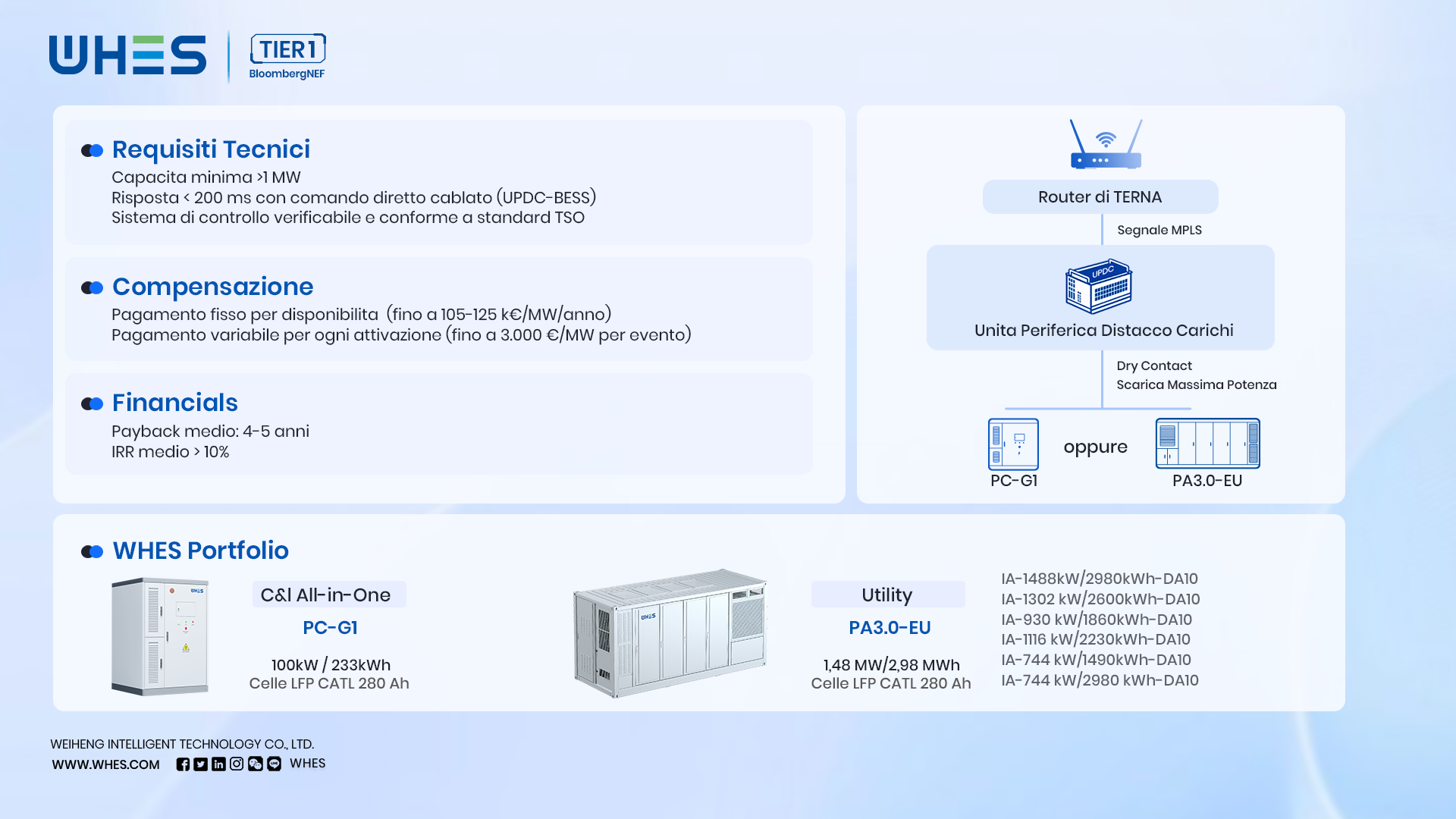
Valerio Covicchio: The service, introduced under the TIDE regulatory framework and awarded through competitive procedures by Terna, includes two revenue components:
• a fixed annual availability payment based on capacity (€/MW per year),
• a variable payment linked to activations, reaching up to €3,000/MW per activation.
These remuneration levels make BESS installations highly attractive for industrial sites. In many cases, projects achieve a 3–5 year payback, double-digit unlevered IRRs, and stable, predictable revenues.
Question: Can WHES batteries also be used for other applications?
Valerio Covicchio: Absolutely. Our products designed for Fast Reserve can perform multiple functions simultaneously:
• photovoltaic self-consumption optimization,
• energy arbitrage,
• peak shaving,
• reactive power compensation.
This approach allows EPCs to offer highly profitable, integrated energy projects.
Question: Are there minimum technical requirements to access the service?
Valerio Covicchio: Yes. According to Terna, resources must ensure extremely fast response times and full controllability. Key requirements include:
• minimum power per site: 1 MW,
• maximum injection response time within 200 milliseconds,
• guaranteed availability of declared monthly capacity,
• high operational reliability.
To meet these requirements, WHES has engineered solutions based on CATL cells, including:
• PC G1 All-in-One cabinet system – 100 kW / 233 kWh, typically for 1–3 MW projects,
• PA All-in-One container system – with various configurations depending on the auction capacity target in terms of MW:
A) 1488 kW / 2980 kWh
B) 1302 kW / 2600 kWh
C) 1116 kW / 2230 kWh
D) 930 kW / 1860 kWh
E) 744 kW / 1490 kWh
Question: What is the ideal customer profile?
Valerio Covicchio: Ideal customers include:
- Energy-intensive industries such as steel, chemicals, cement, glass, paper, and food production, with high-power connections.
- Facilities connected to medium voltage with contracted power above 1 MW.
- Sites with industrial PV installations, enabling higher self-consumption, improved BESS profitability, and shorter payback periods.
Question: What is the role of EPCs in this market?
Valerio Covicchio: EPC companies are key enablers of this emerging market. While many clients already understand the value of photovoltaics and energy efficiency, they are not yet fully aware of the potential of grid services.
Offering BESS systems designed from the outset for Fast Reserve allows EPCs to deliver projects with significantly higher returns compared to traditional installations.
Question: How is the WHES solution structured for this service?
Valerio Covicchio: We have developed a dedicated BESS architecture for C&I applications targeting Fast Reserve participation. The solution integrates:
• certified response times below 200 ms,
• integrated control and telemetry systems,
• architecture optimized for industrial environments,
• one of the best price-performance ratios on the market.
Our goal is to enable EPCs and industrial customers to quickly access the service with a system already compliant with technical and regulatory requirements, supported by top-tier WHES partners.
Question: Does WHES also provide support during the presales phase?
Valerio Covicchio:
Yes. Our team supports EPCs and industrial clients by developing hourly and quarter-hourly revenue models based on real site data. This provides a clear view of both energy and financial performance, helping define optimal system sizing and reducing time-to-revenue.
Question: Thank you, Valerio, for these insights.
Valerio Covicchio: Thank you. For further information, interested parties can contact me directly at Valerio.covicchio@whes-eu.com.