News Details
Powered by AI-native architecture, WHES OS enables intelligent energy management and has been proven to increase revenue by 13.49%
As the new energy sector moves toward full marketization and electricity pricing mechanisms become increasingly sophisticated, competition in the energy storage industry is evolving from a focus on hardware performance to intelligent energy management and operation. On June 2, WHES hosted its 2026 AI+ Energy Storage Product Launch in Shanghai, officially unveiling WHES OS, an AI-native intelligent energy operating system designed for the next generation of energy storage applications.
The newly launched WHES OS represents far more than a conventional feature upgrade. Powered by WHES’ self-developed AI engine, it introduces an AI Agent with advanced intent-recognition capabilities, enabling the system to understand user requirements through natural language interactions and automatically generate optimized energy strategies. This innovation marks a significant transition from automated execution to autonomous, intelligence-driven decision-making.
Intent-Driven Intelligence: Empowering Energy Storage Systems to Understand Instructions, Anticipate Business Needs, and Make Proactive Decisions
Traditional Energy Management Systems (EMS) primarily rely on predefined rules and fixed control logic. In complex operating scenarios - such as sudden production surges, volatile electricity prices, changing weather conditions, or demand charge risks - system performance often depends on repeated manual adjustments and operator intervention.
The key breakthrough of WHES OS lies in its native intent-understanding capability. By leveraging advanced AI technology, the system can interpret user objectives expressed in natural language, enabling energy storage systems to move beyond automated execution and toward autonomous intelligent decision-making.
At the launch event, Zhang Ruixiang, Head of Big Data and Artificial Intelligence at WHES, demonstrated this next-generation interaction model. Instead of configuring complex parameters and operating strategies manually, users can simply describe their objectives in everyday language.
For example, requests such as “We have urgent production orders tomorrow; prioritize power supply to the manufacturing line” or “Reduce electricity costs this week and maximize the use of photovoltaic generation” can be directly understood by the system. WHES OS automatically performs intent recognition, goal decomposition, strategy generation, and constraint verification before executing the optimal energy management plan.
With this capability, WHES OS transforms energy storage from a conventional equipment control platform into a true intelligent energy brain - one that can understand, reason, and proactively optimize energy operations in real time.
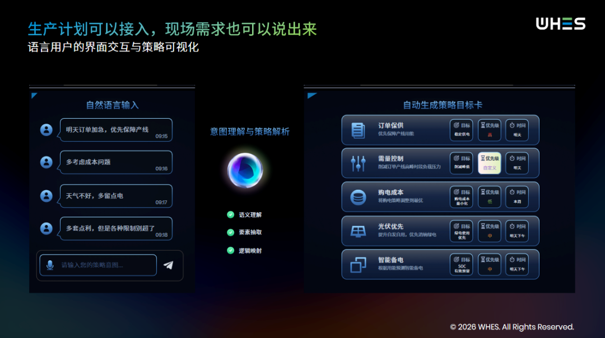
Three Core Capabilities of WHES OS
- Intent Recognition and Goal Reconstruction
The system automatically identifies user intent and converts complex or ambiguous business requirements into structured control strategies, creating a fully automated workflow from demand input and objective decomposition to strategy formulation and implementation. - Automated Goal Configuration
By integrating MES order data, load forecasts, electricity price trends, and battery State of Charge (SOC) information, the system automatically generates multi-dimensional operational objectives and optimization strategies, seamlessly aligning business priorities with energy management decisions. - Dynamic Priority Adjustment
Users can flexibly adjust the priority assigned to key objectives, including production power assurance, demand charge management, electricity procurement costs, and renewable energy utilization. Based on these priorities, the system continuously evaluates available resources and operating conditions to calculate the optimal strategy in real time.
13.49% Measured Revenue Growth: Delivering Stable Returns in a Dynamic Energy Market
The true value of WHES OS extends beyond intelligent automation. Its greatest strength lies in delivering stable, predictable returns in an increasingly complex and volatile energy market.
Leveraging multi-dimensional forecasting, real-time data analytics, and continuous rolling optimization, WHES OS enables users to maximize operational performance while effectively managing market uncertainties. By dynamically balancing electricity prices, load demand, renewable generation, and energy storage resources, the system continuously identifies the most profitable operating strategy under changing conditions.
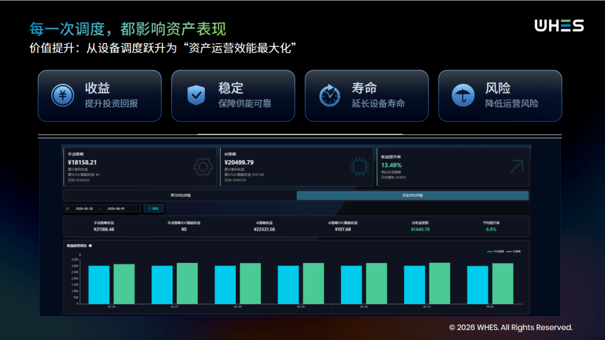
More importantly, the benefits of WHES OS are not merely theoretical. The platform has already demonstrated measurable commercial value in real-world deployments, delivering a verified revenue increase of 13.49% while enhancing operational stability and decision-making efficiency:
-
Significant Revenue Growth
Field tests have demonstrated that projects utilizing the WHES OS AI-powered scheduling engine achieve revenue improvements ranging from 8% to 15%. By continuously analyzing market conditions, load patterns, and energy price fluctuations, the AI engine identifies optimal charging and discharging opportunities that are often missed by conventional rule-based or manually managed systems.
Compared with traditional operational approaches, WHES OS responds more quickly to changing market signals, enabling more accurate energy trading decisions and maximizing value from electricity price differentials. The result is higher revenue generation, improved asset utilization, and more consistent financial performance across varying market conditions. -
Accurate Forecasting and Dynamic Optimization
By integrating meteorological data, historical operating patterns, and MES production schedules, WHES OS accurately forecasts both photovoltaic generation and production line energy demand. This predictive capability enables the system to anticipate changes in energy supply and consumption before they occur, providing a stronger foundation for operational decision-making.
To ensure optimal performance under dynamic conditions, WHES OS performs rolling optimization every 15 minutes, continuously recalculating operating strategies based on the latest system and market data. This allows the platform to respond proactively to unforeseen events, such as sudden reductions in PV generation due to weather changes or unexpected load fluctuations caused by production adjustments, ensuring stable system operation and maximum economic returns. -
Proactive Safety Mechanism
Before execution, every strategy undergoes sandbox simulation and comprehensive safety validation. The system automatically verifies key operational parameters - including SOC limits, power constraints, equipment status, and potential strategy conflicts - to ensure that all scheduling actions remain within predefined safety boundaries.
By combining intelligent optimization with rigorous risk control, WHES OS enables users to maximize operational revenue without compromising system reliability or safety. This proactive approach helps reduce operational risks, enhance asset protection, and ensure stable long-term performance.
Full Closed-Loop Intelligence: Explainable Decision-Making and Proactive O&M
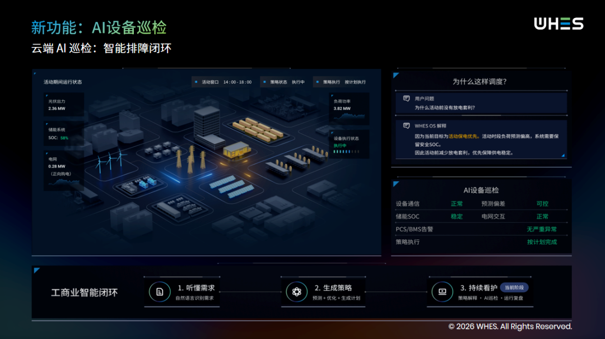
To address the long-standing “black box” criticism of AI decision-making, WHES OS introduces an original AI strategy interpretation and playback function, enabling AI to not only make decisions but also explain them clearly.
- Explainable AI
WHES OS provides full visibility into the reasoning behind every scheduling decision. For example, if a user asks, “Why was no discharge scheduled for arbitrage before the event?”, the system can clearly explain the decision-making process by referencing factors such as load forecasts, SOC safety thresholds, and power supply reliability requirements.
In this scenario, the system may explain that “a portion of potential arbitrage revenue was intentionally sacrificed to maintain a safe SOC reserve and ensure stable power availability for anticipated demand.” By presenting the underlying logic and trade-offs behind each action, WHES OS enables users to understand not only what decision was made, but also why it was made.
This fully traceable, replayable, and explainable decision framework significantly enhances transparency, strengthens user confidence in AI-driven operations, and fosters greater trust in autonomous energy management. - AI-powered Proactive Operations & Maintenance
By combining AI-powered equipment diagnostics with cloud-based digital twin technology, WHES OS transforms operations and maintenance from reactive fault handling to proactive risk prevention. The system continuously monitors equipment health in real time, identifies potential anomalies before they escalate into failures, and enables faster issue resolution through remote expert diagnostics and analysis.
This predictive O&M approach helps operators detect risks earlier, reduce unplanned downtime, and improve overall asset reliability. Supported by a cloud-connected digital twin, WHES OS provides a comprehensive view of system performance, allowing maintenance teams to make informed decisions based on real-time and historical operational data.
According to operational statistics, more than 80% of common system faults can be diagnosed and resolved remotely, significantly reducing maintenance response times, minimizing site visits, and lowering overall O&M costs while ensuring higher system availability.
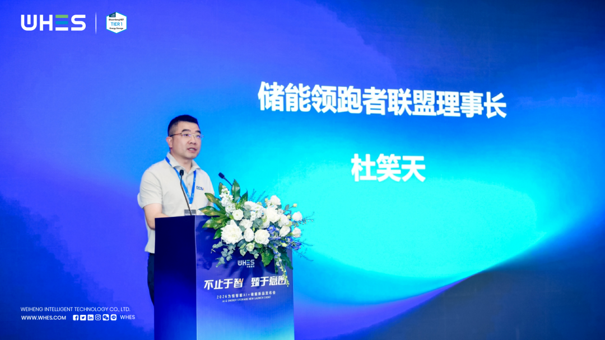
Guest Speakers Discuss Industry Trends and the Transformative Role of AI
The product’s targeted technological breakthroughs, designed to solve longstanding industry challenges and enhance intelligent operations, were highly acknowledged by prominent experts and industry authorities.
Du Xiaotian, Chairman of the Energy Storage Leaders Alliance, stated in his speech that China’s energy storage industry has entered a new phase driven by technological innovation and value reorientation. Building the full lifecycle of energy storage assets via intelligent technology has become an inevitable industry trend. He spoke highly of WHES’ AI+ energy storage products for aligning with industrial development, and looked forward to continued innovation to advance high-quality growth across the sector.
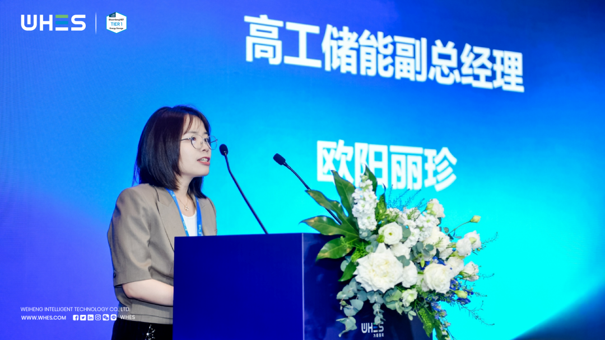
Ouyang Lizhen, Deputy General Manager of Gaogong Energy Storage, noted that energy storage integrated with AI has become an essential solution to meet the power system’s stringent requirements for regulation capability and profitability. She praised WHES for deeply integrating large AI models to elevate energy storage from passive execution to active thinking, expecting the new product to set a new benchmark for the industry’s intelligent transformation.
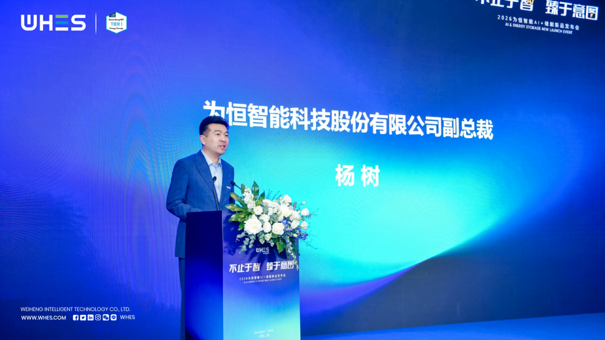
Dr. Yang Shu, Vice President of WHES, emphasized that as policy incentives fade away, industrial and commercial energy storage has fully entered a market-driven era. To solve the widespread dilemma of “assets without returns”, the company launched WHES OS 2.0. By adopting explainable AI agents, the system has developed into a thoughtful energy manager that understands natural language and makes autonomous decisions. It realizes the upgrade from automation to intelligence, helping users secure steady profits in a complex market.
Looking Ahead: The Next Era of AI-Driven Energy Management
Looking ahead, WHES will continue to deepen the integration of AI across energy storage, power trading, Virtual Power Plants (VPPs), and industrial and commercial energy management applications. By combining advanced AI technologies with real-world energy scenarios, the company aims to unlock greater operational efficiency, flexibility, and value for energy assets.
The long-term vision for WHES OS is to evolve into a next-generation intelligent energy operating system capable of autonomous perception, intelligent decision-making, and continuous optimization. Through this AI-native platform, WHES is committed to accelerating the transition toward smarter, more efficient, and more sustainable energy management.