News Details
From Uncertainty to Insight: WHES Upgrades Its AI Forecasting Engine
“Accurate forecasts, yet spot market losses persist. Why? And why do assessment penalties spike whenever the weather shifts?”
A question is increasingly being asked across the renewable energy industry: If a power plant is performing well and has substantial installed capacity, why does market participation remain so challenging?
The reality is that the market has never been concerned solely with how much power a plant can theoretically generate. What truly matters is how reliably it can deliver when it matters most.
A 100 MW solar plant may theoretically reach full output under ideal conditions. But once weather variability, intermittency, and changing system demand are factored in, its actual reliable capacity can be significantly lower. When clouds roll in, wind conditions shift, or demand suddenly spikes, the median forecast alone may no longer be enough - potentially exposing weaknesses in trading strategies, energy storage dispatch, and imbalance management.
Ultimately, profitability depends not simply on “getting the middle number right,” but on understanding the full range of potential outcomes - and the associated risks - before they materialize.
WHES AI by WHES goes beyond the limitations of traditional deterministic forecasting. With an upgraded forecasting architecture that combines probabilistic forecasting and multi-source data fusion, WHES AI shifts the focus from providing a single forecast to revealing the full range of possible outcomes and associated risks.
This enables users to make more robust, forward-looking decisions in uncertain market conditions - advancing energy management from point-based forecasting toward probability-driven decision-making.
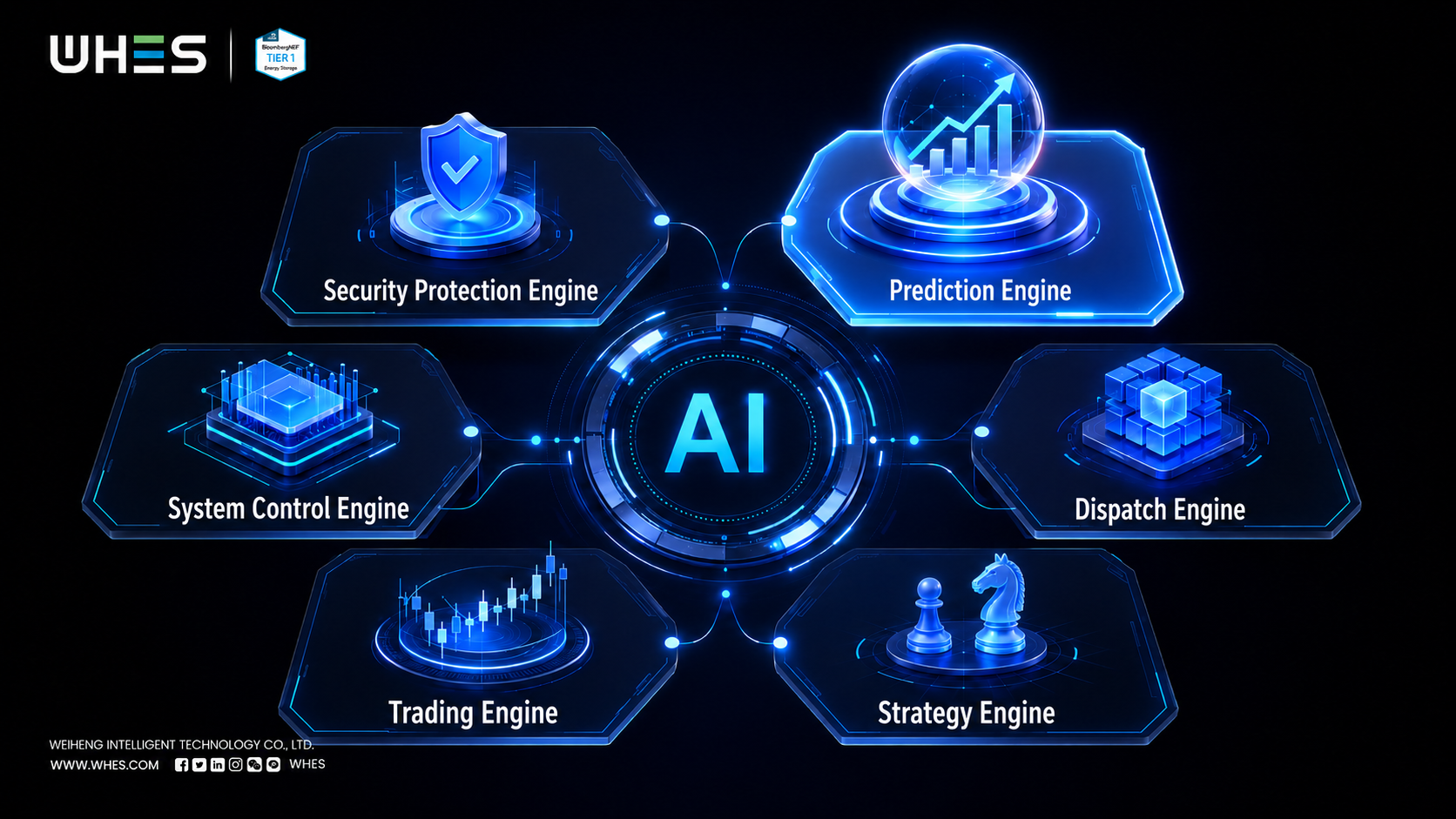
Engine Positioning: A Unified Forecasting Framework for Diverse Energy Scenarios
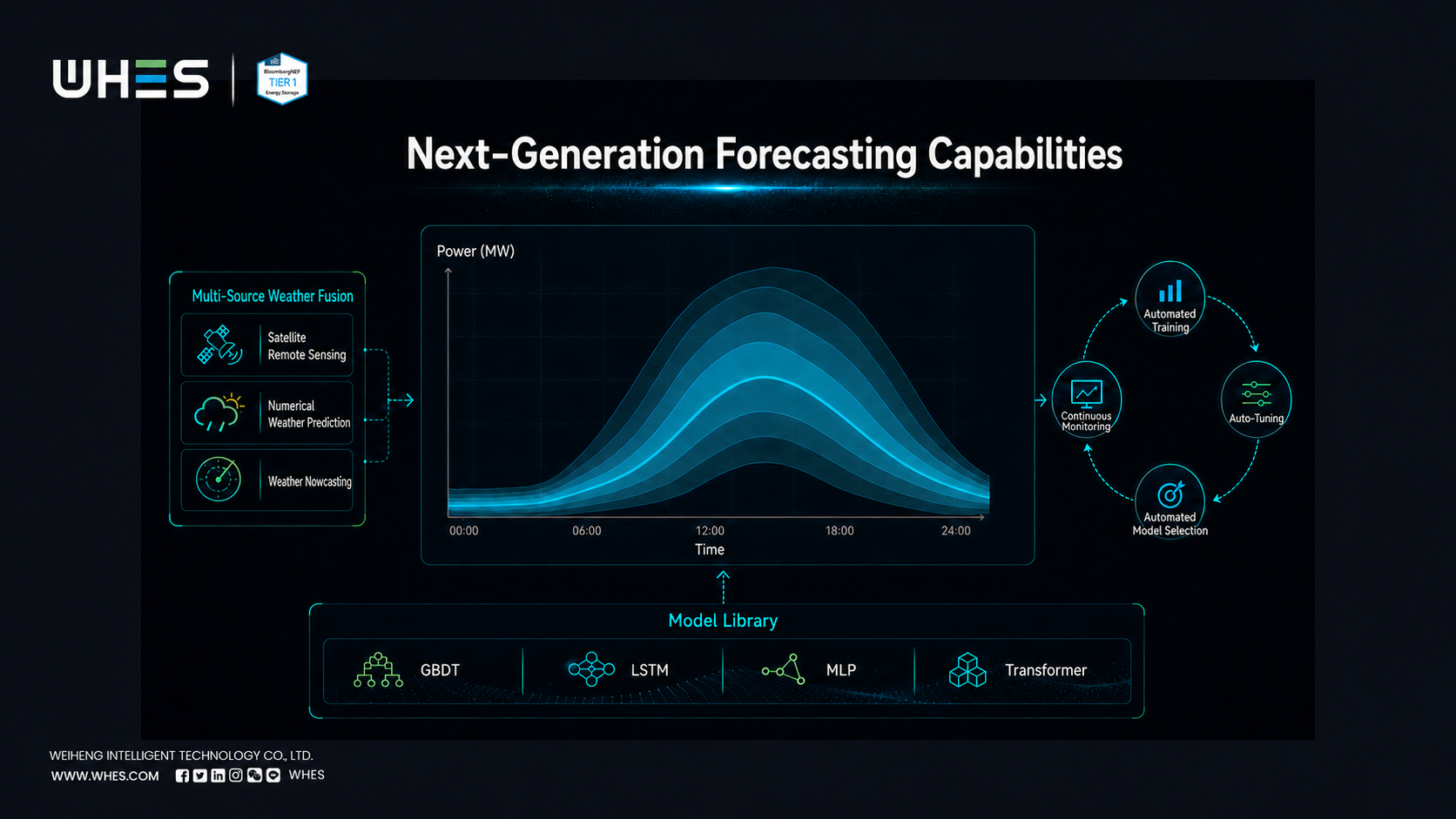
Built on a unified technical foundation, the next-generation forecasting engine provides comprehensive coverage across PV generation and load forecasting, day-ahead and ultra-short-term forecasting, and electricity markets across multiple regions worldwide. At the same time, it introduces significant enhancements to forecasting outputs, weather data integration, and adaptive model updates, enabling more accurate and resilient forecasting across diverse energy scenarios.
- Unified Generation and Load Forecasting: Supports both PV generation and electricity load forecasting within a single platform.
- Global Multi-Market Adaptability: Designed for diverse climate conditions and electricity markets across China, Europe, the Americas, and Australia, with built-in support for different time zones, daylight saving time, and local calendar conventions.
- Full-Scenario Coverage: Supports a broad range of energy applications, from residential and C&I systems to industrial parks and other complex energy environments.
- Multi-Timescale Forecasting: Combines day-ahead forecasting to capture broader supply-demand trends with ultra-short-term forecasting that continuously incorporates the latest weather and real-time operational data for high-frequency rolling updates.
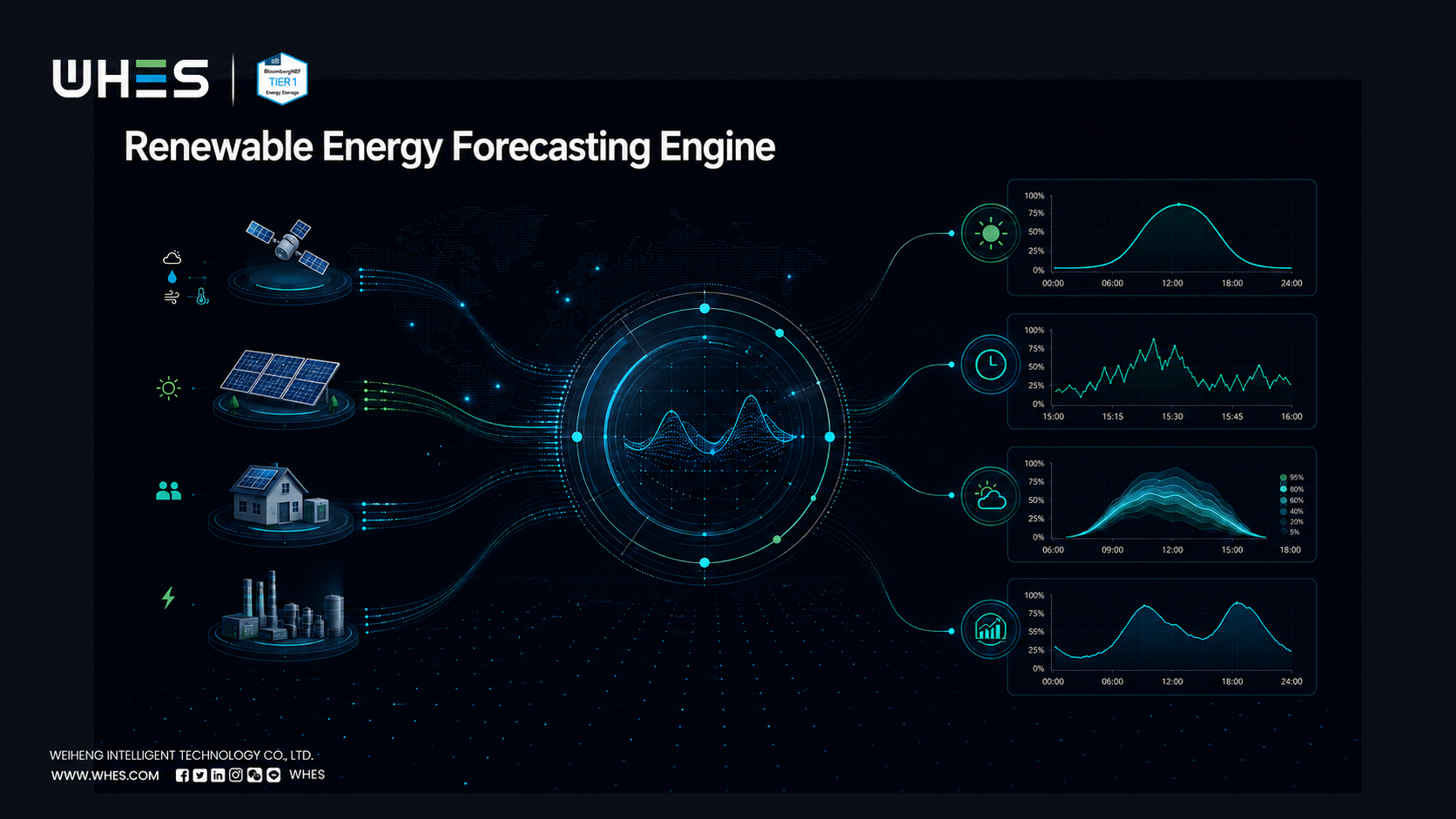
Five-Dimensional Upgrade: A Clearer View of What Lies Ahead
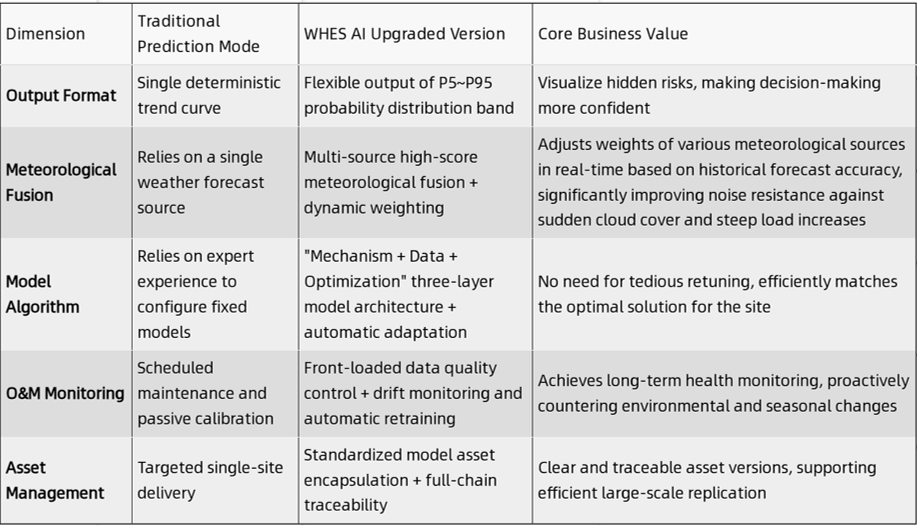
Four Core Capabilities, Upgraded to Look Beyond the Forecast
- Probabilistic Forecasting: Understanding the Full Range of Risk
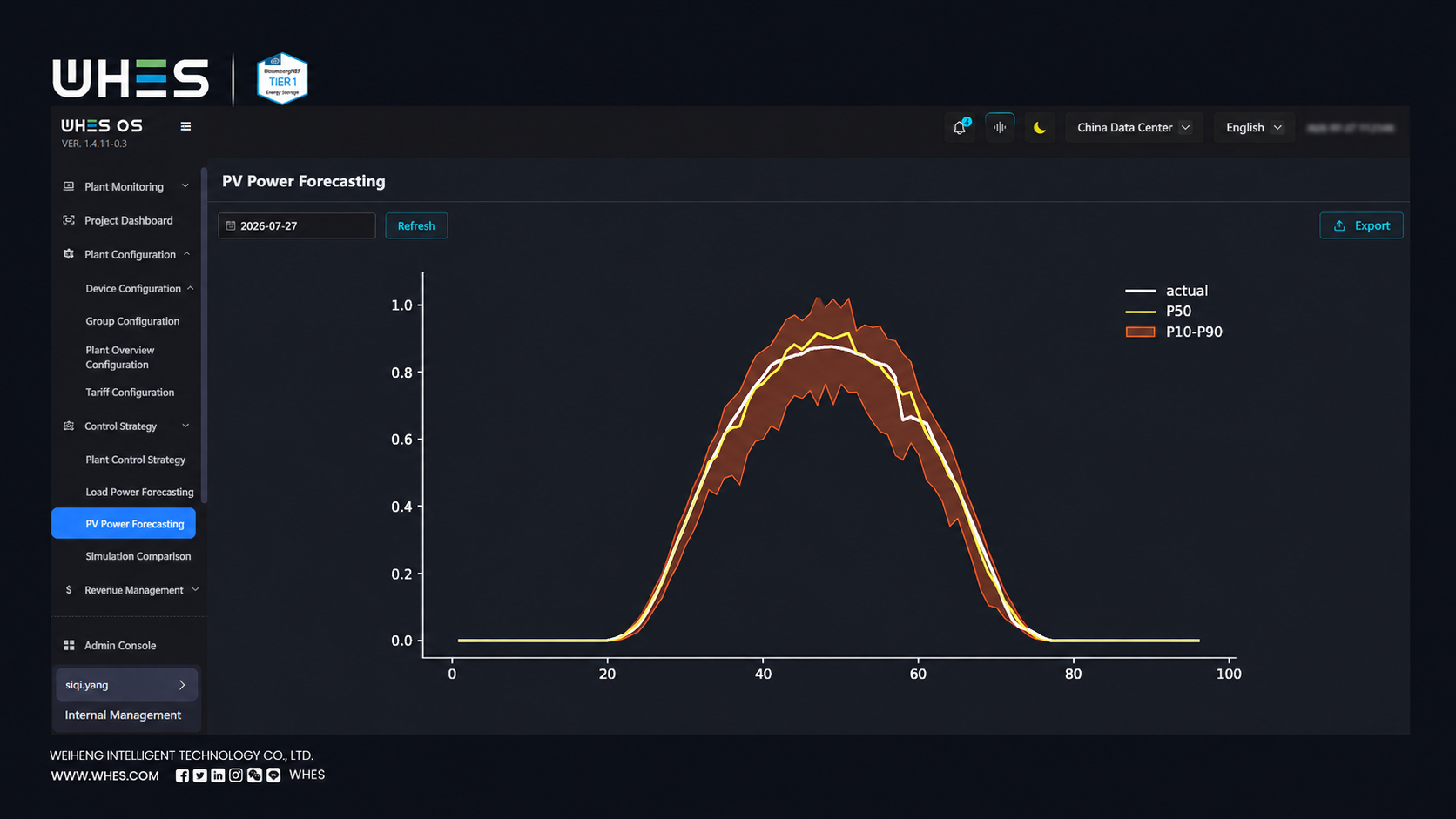
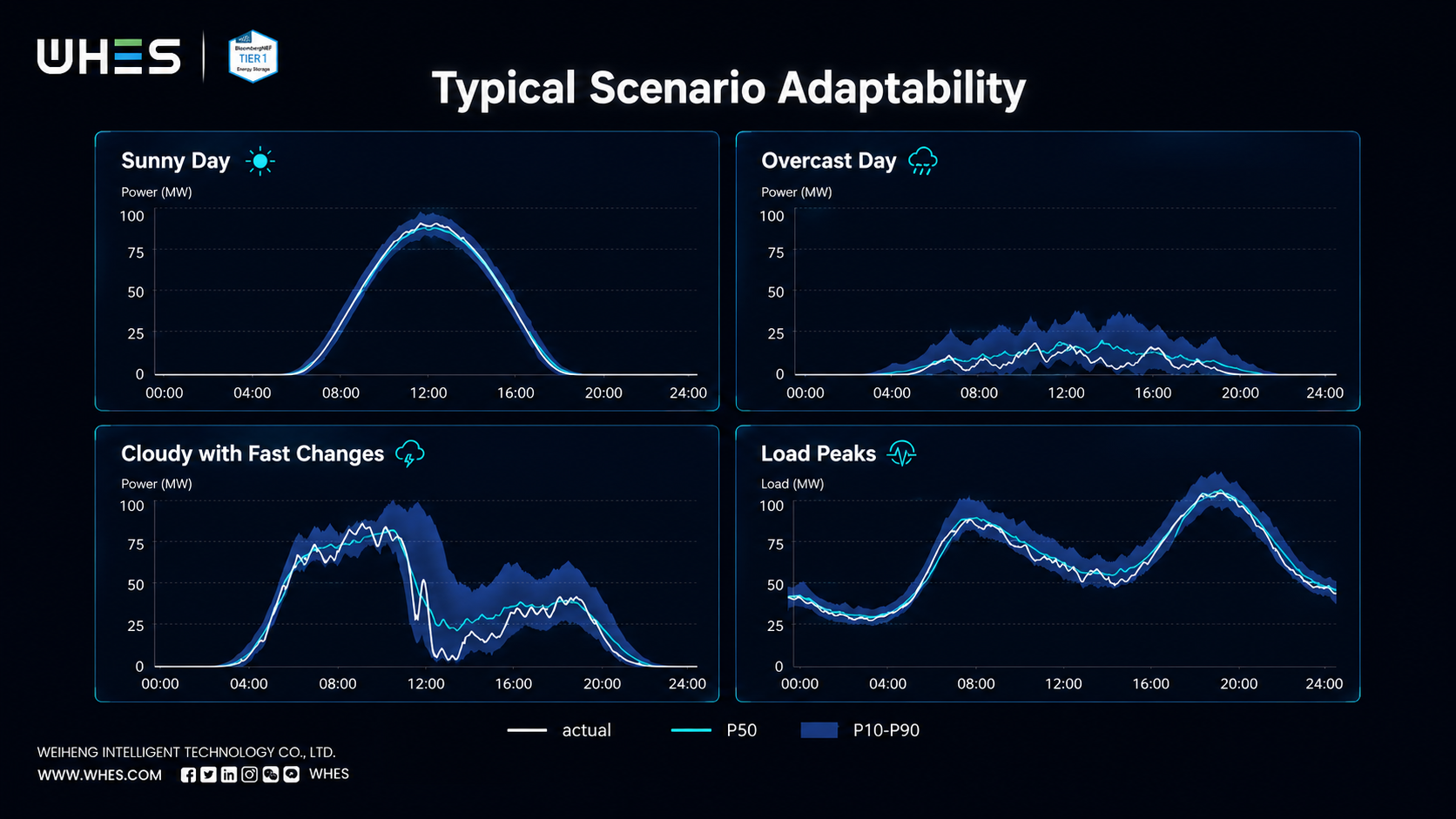
Building on its existing forecasting capabilities, the upgraded engine introduces forecast confidence intervals, providing a clearer view of uncertainty and potential risk. When weather and operating conditions are stable, the forecast range remains narrow, indicating greater predictability. As uncertainty increases - due to factors such as rapidly changing cloud cover or sudden shifts in load - the range widens accordingly, providing an early indication of potential volatility and enabling users to better anticipate risk.
Users can therefore see not only what is most likely to happen, but also the potential range of deviation, enabling more informed and proactive decisions on energy storage dispatch, market bidding, and energy consumption.
- Multi-Source Weather Data Fusion: Anticipating Weather Changes Earlier
The upgraded engine integrates multiple weather data sources with real-time plant operating data, continuously updating forecasts as conditions evolve.
For day-ahead and longer-term horizons, the platform provides a clearer view of overall generation and consumption trends. For near-term changes, it responds more quickly to factors such as cloud movement, irradiance fluctuations, and sudden shifts in load.
The platform also automatically selects the most suitable weather data sources based on region, season, and forecast horizon, helping improve the timeliness, consistency, and reliability of forecasts.
- One Site, One Strategy: Automatically Selecting the Right Forecasting Approach
Different regions and sites have distinct operating characteristics, which means forecasting cannot rely on a one-size-fits-all approach.
The upgraded platform considers regional climate conditions, system scale, historical operating performance, and seasonal patterns to automatically identify and apply the most suitable forecasting strategy for each site.
At the model level, the platform combines physics-based modeling with AI algorithms. For example, in large-scale solar-plus-storage projects in northwestern China, PV generation mechanisms and irradiance characteristics are incorporated to better define the forecast range and improve adaptability to changing weather conditions. For C&I users in southeastern coastal regions, machine learning models analyze patterns across multiple data sources - including production schedules and weather conditions - to improve load forecasting accuracy.
Users can therefore focus on their business objectives rather than the complexity of the underlying models. The platform continuously monitors forecasting performance and automatically optimizes algorithm configurations, allowing its forecasting capabilities to adapt and improve alongside each site’s operation - truly delivering “one site, one strategy.”
- Data Anomaly Detection: Ensuring Continuous Forecasting
Weather conditions, equipment status, and energy consumption patterns are constantly evolving, requiring forecasting capabilities to adapt accordingly.
The upgraded platform automatically detects missing, abnormal, or delayed data before it enters the forecasting process, helping ensure data quality from the outset. During operation, it continuously monitors forecast performance and stability. If deviations begin to increase, the platform automatically adjusts and updates the model to reflect changing site conditions.
Through this continuous monitoring and optimization, forecasting capabilities evolve alongside each site, helping maintain stable, reliable, and accurate performance over the long term.
Forecasting Across Diverse Decision-Making Scenarios
- PV Generation: By presenting low, baseline, and high generation scenarios, WHES AI enables users to anticipate output variations under different weather conditions and optimize energy storage charging and discharging, electricity purchasing and sales, and grid interaction strategies. This helps reduce risks and costs associated with imbalance penalties, renewable energy curtailment, and reverse power flow.
- Electricity Load: By clearly presenting baseline, normal, and peak load scenarios, the platform helps users anticipate potential demand peaks and optimize capacity planning, demand management, and demand response strategies. This enables more proactive energy management while reducing the risk of exceeding maximum demand limits and incurring high electricity costs during peak periods.
- Energy Storage & Electricity Trading: Based on dynamic forecast ranges, the platform can continuously optimize charging and discharging schedules and trading strategies, balancing operational flexibility with market opportunities. This helps reduce underutilized capacity, dispatch mismatches, and trading deviations while improving the overall operational efficiency and value of energy assets.
- Seamless Integration with Downstream Systems: Forecast results can be directly integrated with energy storage dispatch, demand response, Virtual Power Plant (VPP), and electricity trading systems, turning different forecast scenarios into actionable dispatch and trading strategies. By enabling earlier risk identification, more efficient resource allocation, and better-informed dispatch and trading decisions, WHES AI transforms forecasting insights into tangible business value, helping reduce costs and improve overall operational efficiency.
Continuous Model Optimization: Adapting to Real-World Operations
From predicting a single possible future to understanding a range of possible outcomes, WHES AI continues to evolve to address extreme weather events, sudden load fluctuations, and the growing complexity of managing and coordinating large-scale energy assets.
From optimizing the energy value of individual sites and energy storage assets to enabling coordinated optimization across Virtual Power Plants (VPPs) and cross-regional asset portfolios, WHES AI will continue to deliver faster, more robust, and more forward-looking forecasting capabilities.
By providing greater visibility into complex weather dynamics and anticipating changes in electricity market conditions, WHES AI turns uncertainty into actionable insights - helping transform risk into more predictable opportunities for value creation.