
Blog
What to Look for When Reviewing ESS Certifications
Certifications are often the first documents buyers review when evaluating an energy storage system manufacturer. However, simply confirming that a product is certified is not enough. The real value lies in understanding what those certifications reveal. Here are five key aspects worth examining: certification breadth, issuing body, certification depth, standard version, and transparency.
Certification Breadth
Certifications map directly to markets. A manufacturer that claims a global footprint but holds certificates for only one or two regions is a manufacturer to approach with caution. It is recommended to choose a supplier whose certifications already cover the regions you may expand into. In that case, when you expand across regions later, you don’t have to switch manufacturers, avoiding unnecessary replacement costs and minimizing interoperability challenges.
WHES has built a market presence backed by a broad portfolio of regional certifications. The published certifications cover key markets across Europe, including the EU, UK, Germany, Italy, Spain, Belgium, Denmark, Sweden, Poland, and France, as well as Australia, South Africa, Thailand, the Philippines, and Malaysia. For buyers with current or future cross-regional projects, that breadth matters. It indicates that local compliance requirements have already been addressed in multiple markets, reducing uncertainty.
Issuing Body
The issuing body on the certificate matters. Certifications from internationally recognized bodies such as TÜV SÜD, UL, and VDE carry independent test data. They require the manufacturer to submit products to accredited labs, maintain documentation, and pass audits. Certifications issued through less rigorous or self-affiliated bodies carry far less weight.
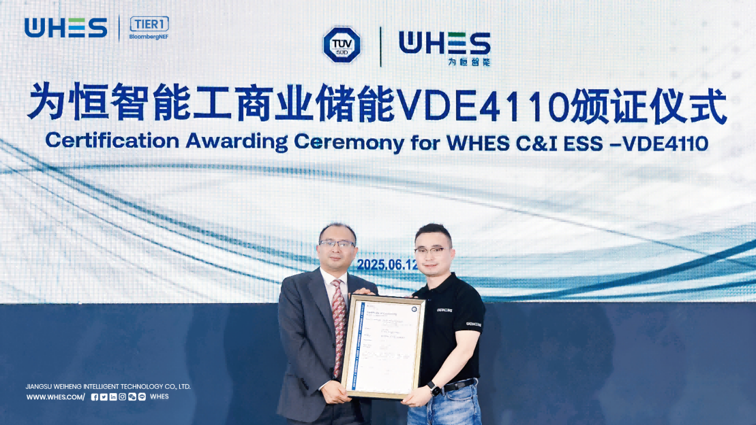
WHES is among the few energy storage system manufacturers globally that hold both UL 9540A, the benchmark thermal safety standard for energy storage systems in North, and VDE-AR-N 4110, Germany’s stringent medium-voltage grid connection requirement. These two certifications represent independent, third-party validation of a product’s safety and grid performance.
The VDE 4110 certification was granted by TÜV SÜD to WHES’s PC-G2 C&I energy storage system at the 18th SNEC International Photovoltaic Power Generation and Smart Energy Exhibition, following a comprehensive assessment based on the VDE 4110 standard. This validates the product’s safety, reliability, and grid connection performance.
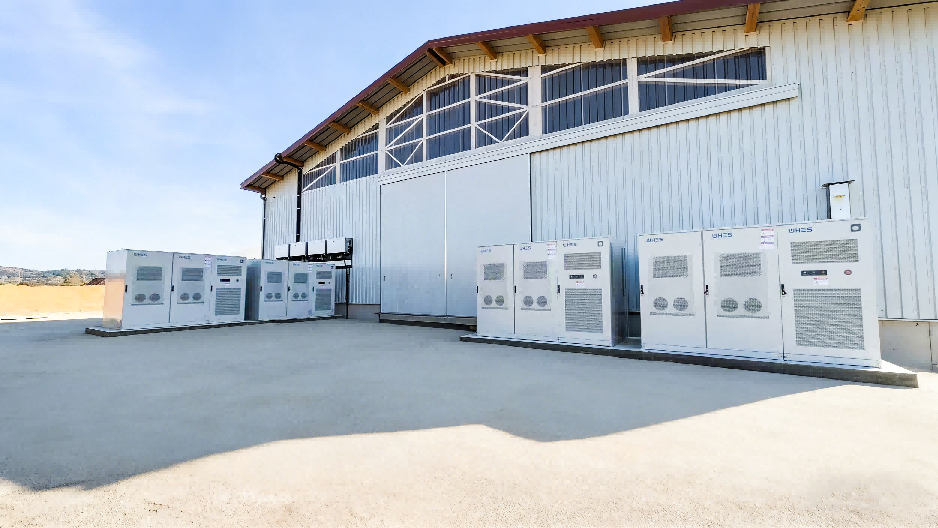
The PC-G1 liquid-cooling all-in-one energy storage system holds the UL 9540A certification, which evaluates energy storage systems for safety under thermal runaway conditions. The PC-G1 underwent a multi-tiered testing process. Results showed no ignition or explosions in the entire unit, stable external wall temperatures, and no impact to adjacent cabinets.
Certification Depth
A safe and reliable energy storage system requires certification at every layer: the battery cell, the module or rack, and the complete integrated system. A certificate that covers only the battery does not necessarily validate system-level behavior under fault conditions.
At WHES, our products carry certifications across multiple technical layers, including IEC 62619:2022 for battery safety, IEC 63056:2020 for secondary lithium cells, IEC 62477-1 for power electronics, and the EN 50549 series for grid connection at both low and medium voltage levels. This is the difference between a product that passes a single test and one that holds up across the entire deployment.
Standard Version
Standards are revised for good reasons. A product certified against a 2016 version of a standard may not meet the 2023 amendment’s requirements for thermal runaway containment, grid frequency response, or cybersecurity. When a manufacturer’s certificates consistently reference outdated editions, it signals that product development may have plateaued.
Staying current with standard revisions also reflects a manufacturer’s broader commitment to quality, as it requires continuous investment in retesting, documentation, and engineering updates.
WHES’s certification portfolio references current standard editions, including IEC 62619:2022, EN 50549-1:2019, CEI 0-21:2022/V2:2024, VDE-AR-N 4110:2023, and TR 3.3.1:2024. Our certification information is updated regularly to reflect the latest standards and regulatory requirements. This means products are aligned with current compliance expectations and better positioned to pass inspection and grid connection requirements in active projects.
Certification Transparency
Certificates with no version number or issue date may reference obsolete standards. A manufacturer that cannot produce the actual certificate documents on request may be referencing third-party component data for a system it did not test as a complete unit.
At WHES, we publish detailed certification information by product model and market, including applicable standards and registration status, and we update this information regularly, with the latest update released in November 2025. We also invite buyers to request the underlying certificate documents directly.
Conclusion
Certifications are a structured record of what a manufacturer has proven, to whom, and under which rules. When you evaluate an energy storage system manufacturer, go beyond the logo list on the product brochure. Ask which version of the standard was tested, who issued the certificate, and whether coverage extends to the complete deployed system.
At WHES, we have built a certification track record that holds up to a high level of scrutiny, across residential, C&I, and utility segments, in more than 50 countries and regions. If you are evaluating energy storage solutions, contact our team for more information.