
Blog
Which Manufacturer Offers Liquid-Cooled All-in-One Energy Storage Systems?
Commercial and industrial (C&I) users increasingly need energy storage systems that offer high energy density, stable battery temperatures, and simple deployment. Liquid-cooled all-in-one systems are designed to meet these requirements.
This article explains what a liquid-cooled all-in-one energy storage system is, what buyers should evaluate when selecting a supplier, and how we at WHES provide integrated solutions for C&I projects.
What Is a Liquid-Cooled All-in-One Energy Storage System?
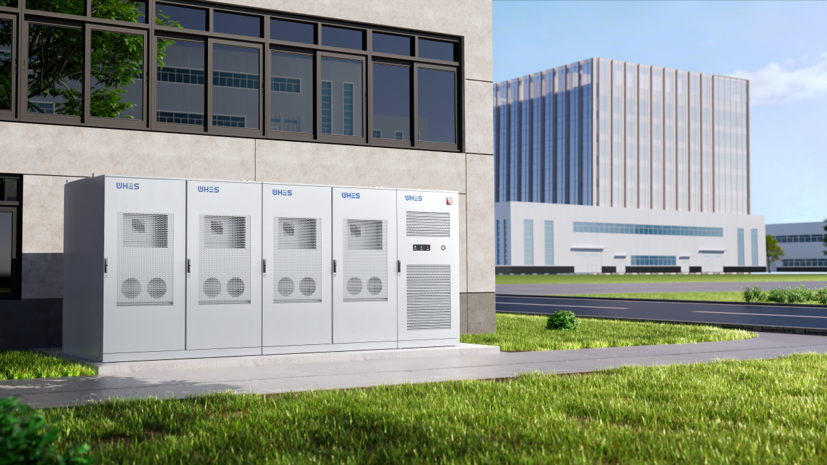
A liquid-cooled all-in-one energy storage system integrates the batteries, power conversion system (PCS), battery management system (BMS), energy management system (EMS), liquid-cooling equipment, high-voltage equipment, electrical protection, and fire-protection functions into one cabinet.
Because these components are integrated and connected at the factory, an all-in-one system reduces the amount of work required onsite. The cabling between the batteries, PCS, and control equipment is completed before shipment, so installation is largely limited to connecting the cabinet to the grid and the site loads, and commissioning is simpler. The compact cabinet also occupies less space, which matters at factories, commercial buildings, data centers, and industrial parks where usable land or equipment-room space is limited.
The use of liquid cooling further supports this compact design. Compared with air cooling, liquid cooling transfers heat through coolant circuits positioned close to the battery modules. This allows heat to be removed more directly and helps maintain a more uniform temperature across cells and modules. Lower temperature differences can reduce uneven battery aging, and more effective heat removal supports compact cabinet layouts. Liquid cooling can also provide more consistent thermal control during frequent cycling, high power demand, or hot-weather operation.
What Should You Check When Evaluating a Manufacturer?
Buyers should examine not only the equipment list, but also how the system will be installed, approved, operated, expanded, and maintained.
1.Confirm What Is Actually Integrated
Request an architecture diagram showing the battery racks, PCS, BMS, EMS, cooling unit, high-voltage equipment, protection devices, and communication interfaces. Confirm which connections and tests are completed at the factory. This determines the remaining onsite work and clarifies responsibility if subsystems do not communicate correctly.
2.Examine Thermal and Fire-Safety Design
Ask about coolant-loop design, temperature-uniformity testing, leak detection, operating limits, and power derating at high temperatures. Separately examine fire detection, alarms, suppression, and isolation. These details affect battery operating consistency, site risk assessments, permitting, insurance review, and emergency planning.
3.Verify Compliance for the Exact Model and Market
Certificates and reports should identify the model, bill of materials, standard edition, tested level, and applicable market. UL 9540 addresses complete energy storage system safety, whereas UL 9540A is a thermal-runaway propagation test method. Assuming that one document applies to every configuration can delay grid approval or require redesign.
4.Review EMS and Remote O&M Functions
Confirm what operating data, alarm records, scheduling tools, tariff controls, demand-management functions, and third-party interfaces are available. Also ask whether monitoring can operate through the cloud, locally, or within a private network. The selected monitoring setup affects daily operation, fault investigation, data management, and integration with other site systems.
5.Check Expansion and Service Requirements
Verify parallel-unit limits, communication architecture, transformer and switchgear requirements, and whether future cabinets can be added without redesigning the site. Review spare-parts availability, technician support, warranty terms, and the contractual meaning of service-response commitments.
Which Manufacturer Provides Liquid-Cooled All-in-One C&I ESS
At WHES, we provide liquid-cooled all-in-one energy storage systems for C&I sites with different power, capacity, and space requirements.
PC-G1: Integrated Design for Simplified Deployment
Our PC-G1 is rated at 100 kW/233 kWh. It integrates LFP battery modules, PCS, BMS, EMS, a high-voltage box, and a liquid-cooling system in one cabinet measuring 1,400 × 1,350 × 2,100 mm.
The battery modules use intelligent liquid cooling. By circulating coolant close to the battery modules, the system is designed to keep the temperature difference between cells within 2°C. More uniform battery temperatures help reduce uneven thermal stress and support consistent operation during repeated charging and discharging.
For protection, the PC-G1 uses a four-level structure covering the pack, rack, PCS, and complete system, together with an independent manual service disconnect. It also incorporates smoke and heat detection, audible and visual alarms, and aerosol suppression.
It is globally certified as a proven commercial battery storage system across 50+ industries worldwide, with listed standards and test references including EMC, IEC 62619, EN 50549, G99, VDE-AR-N 4105, CEI 0-16, CEI 0-21, AS/NZS 4777.2, C10/11, UL 9540A, and UN 38.3.
PC-G3: High Energy Density in a Compact Cabinet
Our PC-G3 provides 125 kW/261 kWh in a cabinet measuring 1,000 × 1,500 × 2,250 mm. Its design achieves an energy density of 174 kWh/m² and supports side-by-side installation.
The compact cabinet and side-by-side layout help project owners install more storage capacity within a limited area. This can be particularly useful at factories, commercial buildings, industrial parks, and other sites where storage must fit around existing production equipment, access routes, or electrical infrastructure.
As with the PC-G1, the PC-G3 uses liquid cooling for the battery and air cooling for the PCS. The system also combines detection, suppression, and isolation functions with four levels of electrical protection.
Its listed standards and test references include IEC 62477, IEC 61000, IEC 62109, IEC 62619, IEC 63056, EN 50549-2, EN 50549-10, UL 9540A, and UN 38.3. For larger projects, up to 24 PC-G3 units can operate in parallel in an on-grid configuration.
Both PC-G1 and PC-G3 work with WHES OS for system monitoring and energy management. Depending on the project configuration, the platform can support operating strategies such as peak shaving, time-of-use optimization, solar self-consumption, and demand control.
Conclusion
A liquid-cooled all-in-one energy storage system can give C&I users a compact, factory-integrated platform with controlled battery temperatures, simplified deployment, and centralized energy management. Its value, however, depends on correct sizing, verified compliance, layered safety design, and long-term service support.
At WHES, we offer the PC-G1 and PC-G3 for businesses seeking integrated, liquid-cooled C&I storage. Contact us for a technical consultation, project-specific system proposal, or quotation based on your load profile, tariff structure, installation conditions, and expansion plans.