
Blog
What Is O&M Support in Commercial ESS And Why It Matters
Many procurement teams treat a commercial energy storage system as an asset that runs itself after installation. The real cost exposure begins the moment that mindset takes hold. Operations and Maintenance (O&M) support is the backbone that determines whether a system delivers its projected ROI or loses value. Underweight it in sourcing decisions, and the financial losses build up quietly.
What O&M Actually Covers in a Commercial ESS
In general, O&M spans four aspects, each essential to long-term asset performance.
1.Preventive Maintenance
This includes periodic cell-level diagnostics and capacity testing, inspection of thermal management systems across cooling units and liquid cooling loops, BMS firmware updates and parameter recalibration, as well as fire suppression system testing.
2.Corrective Repairs
This covers fault diagnosis, root cause analysis, and module- or rack-level replacement, all carried out under clearly defined response commitments when unexpected failures occur.
3.Performance Analysis
This covers real-time monitoring of state-of-charge (SOC), battery health, and overall system efficiency, which helps detect abnormalities early and allows issues to be addressed before they develop into major failures.
4.Operational Optimization
Charging strategy tuning for peak shaving and demand charge management, dispatch algorithm updates aligned with tariff changes, and performance benchmarking against original design specifications all belong under O&M.
What Are You Risking Without Proper O&M
Without proper O&M support, businesses put their return on investment (ROI) at risk in ways that are not always immediately visible.
In a commercial ESS, thermal management components can wear down and lose efficiency. Connectors may loosen and corrode. Without preventive maintenance, these issues develop quietly in the background for months until a fault surfaces and forces an unplanned shutdown. For a commercial energy storage system operating in peak shaving or energy arbitrage applications, every hour offline means missed savings.
When failures do occur, the cost of response is also significantly higher than it would have been had the issue been caught earlier. According to the U.S. Department of Energy, reactive maintenance for energy assets can cost three to five times more than preventive maintenance, once overtime labor, expedited parts, downtime, and secondary damage are factored in.
Beyond failure risk, poor O&M also erodes the system’s ability to perform its core economic function. Peak shaving, for example, depends on the system dispatching accurately against real-time load profiles. Without regular charging strategy reviews and dispatch updates aligned with current tariff structures, the system may no longer be optimized for the actual conditions it operates in.
Over the long term, the economic gap only becomes difficult to ignore. A system purchased at a lower upfront price but supported by weak O&M coverage will often end up with a higher Levelized Cost of Storage (LCOS) across its operational life. The ROI difference between a well-maintained system and a neglected one tends to widen year after year.
How WHES Approaches O&M Support
At WHES, we build O&M capability directly into our systems through WHES OS, our proprietary Energy Management System (EMS).
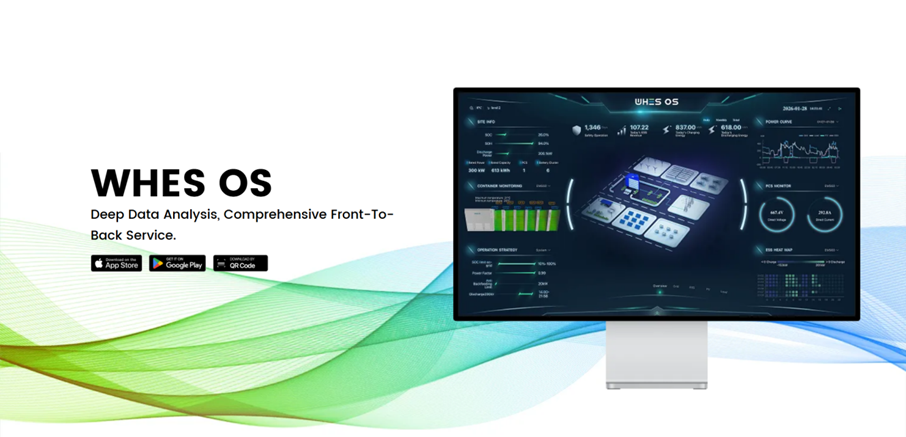
On the storage side, WHES OS EMS performs continuous online assessment of State of Health (SOH) and Remaining Useful Life (RUL) at the cell level, using that data to optimize charge and discharge depth and extend asset lifespan. It also runs consistency diagnostics across battery clusters, identifying imbalances, improving available capacity and energy utilization, and reducing the risk of serious faults before they develop.
For systems paired with photovoltaic (PV) generation, WHES OS monitors generation output at the string and inverter level, automatically identifying and quantifying underperformance. Early detection of PID (Potential Induced Degradation) effects and inverter performance variance means issues are flagged before they translate into measurable energy loss.
WHES OS also adapts dispatch strategy to actual site conditions. For peak-valley arbitrage, the platform applies AI-driven scheduling that draws on historical energy consumption data, weather patterns, geographic inputs, and market pricing information to optimize charge and discharge timing, maximizing the value captured from electricity price differentials.
For scheduled preventive maintenance, we follow structured inspection intervals: a full electrical connection and safety check at first grid connection, a six-month inspection covering ESS structural integrity, cable condition, emergency stop functionality, and warning label status, and an annual deep inspection covering contactors, SPD/fuse condition, grounding resistance (must not exceed 4 Ω), cable insulation, and surge protection devices.
When corrective maintenance is required, our local service teams are on-site within 48 hours, with most common faults resolved within 72 hours. Our technicians hold certified electrician qualifications and bring extensive experience in renewable energy systems. They are equipped with a full suite of PPE and undergo regular safety and technical training, backed by a structured safety framework that includes a dedicated Field Maintenance Safety Manual covering on-site standards, training protocols, and PPE management.
We also operate 21 overseas spare parts warehouses across Europe, the Middle East, Africa, Oceania, and Asia, with an additional North American warehouse currently under development.
In short, we provide 24/7 maintenance support, spare parts services, routine inspections, deep preventive maintenance, risk management, operations management, and digitalized service management across the full lifecycle of the system.
Conclusion
A commercial energy storage system is a capital-intensive, performance-sensitive asset operating in a complex and evolving energy market. Its financial returns depend not only on the quality of the hardware at the point of installation, but on the rigor and continuity of operations and maintenance across its full lifecycle.
For those looking for a partner that covers both hardware and long-term O&M support, talk to our team.