
Blog
How to Choose the Best ESS Provider for Your Solar Setup
The commercial and industrial energy sector has moved fast. Solar generation alone does not cover the full picture. Storage is now the deciding factor in project economics. For companies developing C&I solar projects, the choice of an energy storage system provider carries long-term consequences.
This article will walk through technical compatibility, certifications, warranty terms, and after-sales support to help identify reliable energy storage system providers.
Evaluate Technical Compatibility
Technical alignment between the solar array and the energy storage system is the foundation of any successful C&I project. Before comparing providers, map out your own project parameters: How many strings of solar arrays does the installation involve? How are they oriented? What are the expected input voltage and current values across those strings?
These questions define your requirements before a single product datasheet is opened. A project with multiple string groups across different orientations, for instance, demands a system with sufficient MPPT channels to track each group independently. A project with strong solar generation but relatively low daytime consumption benefits from a higher PV oversizing. And the DC input voltage range must accommodate your chosen module configuration.
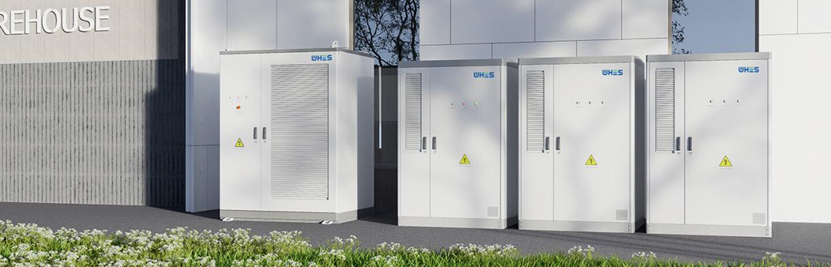
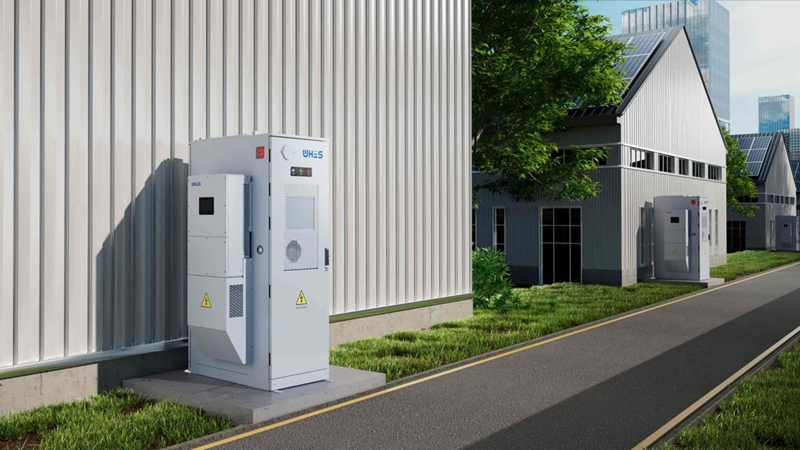
At WHES, we provide a wide range of C&I ESS solutions. Our PC-mini, for example, is available in four models with a battery cabinet capacity range of 57 to 100 kWh. It supports up to four MPPTs with up to eight input strings in total, a maximum PV input current of 20 A per string, and a 200% PV oversizing, providing the flexibility needed for varied PV array configurations on-site.
Additionally, its EPS function can switch to backup power in under 10ms, ensuring stable operation under complex power conditions. The PC-mini can handle 100% unbalanced loads, accommodating the uneven three-phase load distribution typical of many C&I sites.
For larger facilities requiring greater capacity, up to six units can operate in parallel (both on-grid and off-grid) without compromising system reliability. And with noise levels below 65 dB, the PC-mini can be deployed across a wide range of site types, including those with occupied spaces or noise-sensitive surroundings.
Check Certifications and Compliance
Certifications are the legal and technical prerequisites that determine whether a project can connect to the grid, clear customs, and pass local authority inspections. The categories to verify span safety certifications (such as UL 9540A for thermal runaway fire propagation), grid compliance approvals (such as EN 50549 for EU markets, VDE-AR-N 4105 for Germany, or AS/NZS 4777.2 for Australia), and any market-specific listings or registrations required by the local distribution network operator.
Without the right certifications in place, a project risks permit rejections, grid connection delays, or regulatory fines, all of which erode the financial case before the system even goes live.
When evaluating a provider, request the actual certificate documents. Verify the issuing body, the scope of the certificate, and the model number it covers. A certificate issued for one product variant does not automatically extend to another.
WHES maintains a comprehensive certification portfolio across multiple markets, updated regularly to reflect the latest standards and regulations. For the full list of certificates by product and country, visit the WHES Certification page.
Inspect Warranty Terms
Warranty terms in the ESS industry vary across providers. Duration alone is not a reliable indicator of coverage quality. A longer warranty period means little if the conditions for activation are narrow, the scope excludes key components, or the claims process places an unreasonable documentation burden on the buyer.
Key questions to raise with any provider include: What triggers the start of the warranty period, shipment date or first installation? Does the warranty cover both the battery pack and ancillary components, or only the cells? What documentation must the buyer submit to activate coverage?
Capacity retention at a defined depth of discharge and cycle count are equally important as the duration itself. A system rated for 8,000 cycles, for instance, tells a very different story depending on whether the daily use pattern involves one or two full cycles. Request these figures in writing, and cross-reference them against the project’s expected operational profile.
At WHES, we maintain transparent warranty terms for our C&I products, covering hardware support, performance benchmarks, and claims procedures for professional purchasers. For the full details, visit the WHES Warranty page or contact us directly.
Assess After-Sales Support
A system that performs well at commissioning but receives slow or inadequate support over its operational life creates real financial risk. Evaluating a provider involves assessing their ability to coordinate across the project lifecycle and their responsiveness when issues arise.
Concrete indicators to look for include the number of regional service centers, average response time for on-site support, availability of remote diagnostics, and clarity of the escalation process. For projects in markets with limited local infrastructure, ask whether the provider has a direct presence in the target country or relies entirely on third-party distribution. The distinction matters significantly when a fault requires field resolution under time pressure.
At WHES, we operate 20+ global service centers, with on-site arrival within 48 hours and resolution of common issues within 72 hours. We also maintain 21 overseas spare parts warehouses across Europe, the Middle East, Africa, Oceania, and Asia, with an additional North America facility in preparation, ensuring fast system recovery without parts delays.
Conclusion
The right energy storage system providers bring technical depth, regulatory compliance, credible warranty terms, and field service capability together in a single, coherent offering. With a comprehensive range of C&I ESS solutions, WHES stands as a strong candidate for project developers.
Explore our C&I ESS solutions and request a technical consultation today.