
Blog
What Really Impacts ROI in C&I Energy Storage Systems
The energy storage industry is transitioning from an era of short-term arbitrage to one centered on full-lifecycle value maximization. The market has evolved from a focus on low-cost products toward a demand for high-quality equipment and comprehensive services.
As a globally leading digital energy service provider, WHES’s answer to this shift centers on a “full-chain service ecosystem combined with multi-scenario adaptability.”
In the past, many C&I energy storage system manufacturers blindly cut prices to expand market share. However, after a period of operation, it became apparent that poor equipment reliability and frequent outages had a far greater negative impact on annual returns than anticipated. In contrast, equipment with slightly higher upfront costs but superior reliability consistently delivered stronger overall returns.
Given that energy storage systems have an operational lifespan of over a decade, Dr. Yang Shu, Vice President of WHES, emphasized that the core competitiveness of energy storage can no longer be defined by equipment price alone. Instead, the industry must pursue a dual enhancement of “efficiency and profitability.”
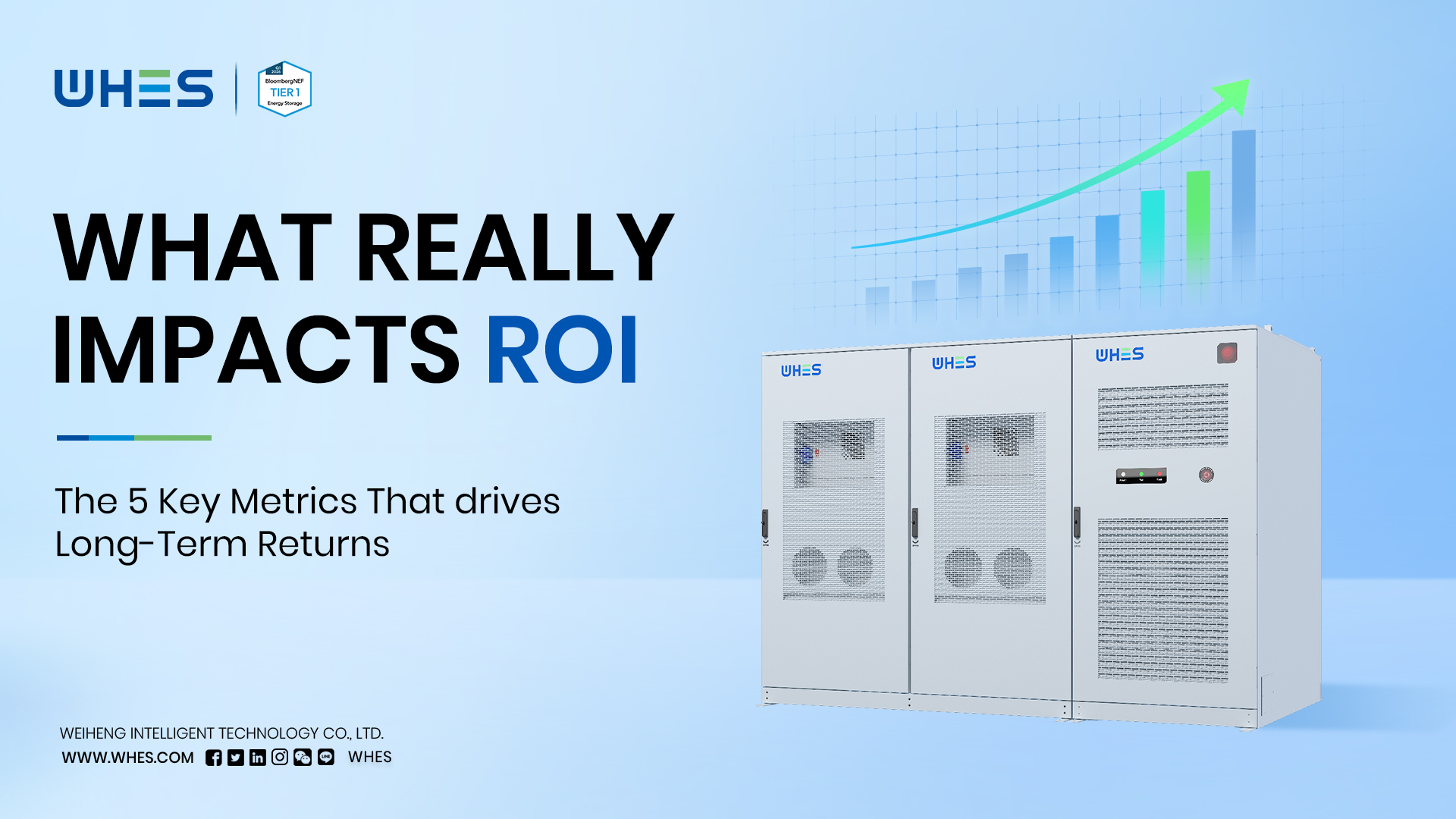
Through financial modeling, Dr. Yang identified that beyond the static capital cost, five key operational metrics have a decisive impact on a project’s Internal Rate of Return (IRR) and long-term revenue: operating days, battery degradation rate, average daily cycle count, charge/discharge efficiency, and Depth of Discharge (DOD).
To illustrate, Dr. Yang analyzed a 10 MWh energy storage project in Chongqing with a total investment of RMB 9 million:
-
Based on the industry-standard assumption of 330 operating days per year, every reduction of 10 operating days causes IRR to drop by approximately 1 percentage point, equivalent to an implicit cost increase of RMB 0.03/Wh, with cumulative 12-year returns declining by 2.79 percentage points. Notably, lower-cost equipment is more sensitive to revenue losses caused by reduced operating days.
-
Every 1 percentage point increase in annual battery degradation rate leads to an average IRR decline of 1.15 percentage points, an implicit cost increase of RMB 0.035/Wh, and a 12-year return reduction of 6.46 percentage points.
-
Every 0.1-cycle reduction in average daily cycles results in an average IRR drop of 1 percentage point, an implicit cost increase of RMB 0.03/Wh, and a 12-year return decrease of 3.23 percentage points.
-
Every 1 percentage point decline in charge/discharge efficiency reduces IRR by 0.6 percentage points, increases implicit costs by RMB 0.02/Wh, and lowers 12-year returns by 3.68 percentage points.
-
Every 2 percentage point drop in DOD results in an IRR decline of 0.635 percentage points, an implicit cost increase of RMB 0.02/Wh, and approximately a 2 percentage point reduction in 12-year returns.
When all five factors are compounded, i.e., annual battery degradation increasing by 0.5 percentage points, charge/discharge efficiency declining by 1 percentage point, DOD dropping by 1 percentage point, operating days decreasing by 10 days, and average daily cycle count falling to just 1.9 (merely 0.1 below the theoretical target), the project’s cumulative 12-year return would decrease by RMB 3.03 million, equivalent to one-third of the total investment.
This analysis demonstrates that at an identical capital cost of RMB 0.9/Wh, high-quality equipment delivers significantly superior full-lifecycle returns compared to standard equipment.
“Increasingly, sophisticated third-party investors are no longer focused purely on price. They now require companies to make explicit commitments on these five key metrics and use performance-linked agreements to work backward toward a justified price,” Dr. Yang highlighted. This shift reflects the energy storage industry’s broader transition from price competition to value competition.
Cloud-Edge-Device Synergy: Building a Competitive Moat in Energy Storage Value
Achieving comprehensive optimization across these five core metrics requires a smart, integrated system spanning hardware and software.
WHES’s proprietary cloud-edge-device collaborative architecture provides a robust foundation for high-efficiency operation across an energy storage project’s full lifecycle.
At the heart of WHES’s technology is its independently developed WHES OS EMS, which achieves deep integration through local controllers and cloud-based coordinating controllers. This architecture supports connectivity with PCS, BMS, liquid cooling systems, HVAC, fire suppression systems, and various energy internet terminals, enabling a fully closed-loop management flow:
-
Data acquisition, monitoring, and alerting
-
Load forecasting and optimization
-
Flexible dispatch and response
-
Source-grid-load-storage coordination
-
Virtual power plant (VPP) trading
This directly addresses the longstanding pain point of poor device interoperability in traditional C&I energy storage systems.
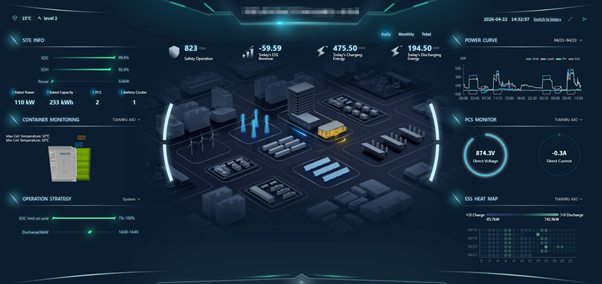
Dr. Yang noted that across WHES’s global portfolio of over 700 projects, the average charge/discharge efficiency has stabilized at 88%, far exceeding the industry average, which is a performance milestone made possible by the WHES OS EMS platform.
Notably, WHES’s “AI and MCP Protocol-Driven Smart Dispatch Service for Solar-Storage-Charging Integration” was honored with the “Annual Innovative Technology” award at the 2025 GGII Golden Globe Awards.
As one of the earliest companies to enter the overseas user-side energy storage market, WHES has developed a deep understanding of international clients’ requirements regarding data security and electricity trading. To date, WHES has established connectivity with grid operators, local EMS platforms, and VPP platforms in more than 50 countries, enabling participation in spot trading, peak shaving, frequency regulation, demand response, and other ancillary services, to help clients unlock diversified revenue streams beyond conventional peak-valley arbitrage.
Improving average daily cycle counts depends on a precise understanding of user load profiles. WHES achieves this by conducting in-depth analysis of each client’s time-of-use load fluctuations and industry-specific operating conditions, enabling customized energy storage capacity configuration solutions.
“A high system availability rate is the foundational prerequisite for maximizing operating days,” Dr. Yang emphasized. WHES has established a globally distributed, locally embedded after-sales operations and maintenance team committed to a 2-hour response time both domestically and internationally. Overseas standards target on-site arrival within 48 hours, resolution of general faults within 72 hours, and complex faults within 120 hours.
Through strategically positioned overseas warehouses and localized spare parts inventories, WHES has established a comprehensive O&M support network. Currently, the average fault repair time across all WHES stations is under 12 hours, with a mean time between failures (MTBF) of 968 hours and annual unplanned downtime not exceeding 5 days — all critical enablers of the company’s high operating-day performance.
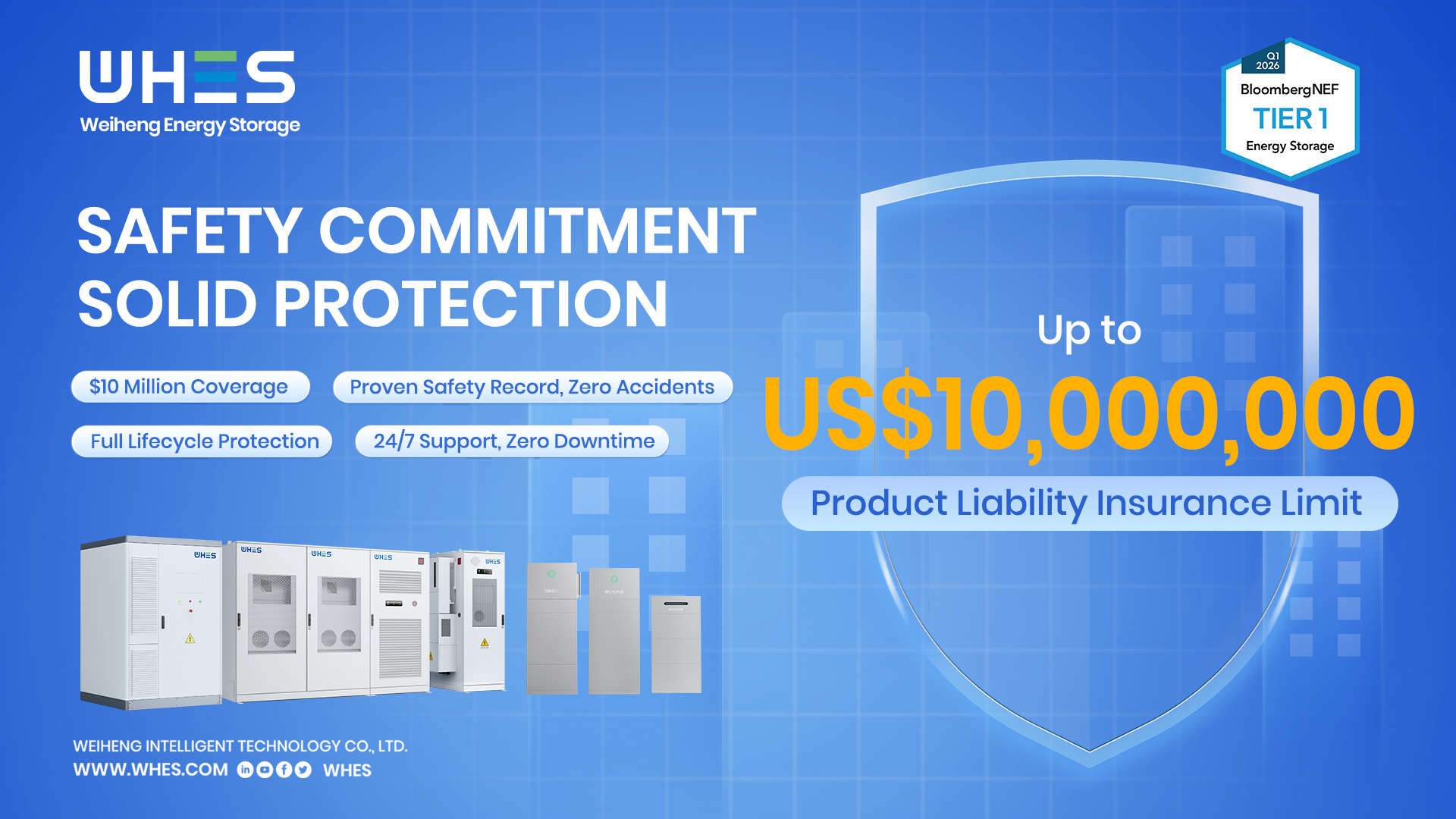
In addition, WHES provides complimentary PICC full-lifecycle insurance coverage of up to USD 10 million for residential and C&I products, offering comprehensive risk protection throughout both the construction and operational phases.
WHES’s full-chain service ecosystem and technical solutions have been validated across projects in more than 50 countries and regions spanning over 40 industries, earning recognition from numerous prominent global enterprises and establishing WHES as a trusted partner for project owners. These achievements have earned WHES the “Annual Overseas Pioneer” award at the 2025 GGII Golden Globe Awards.
Looking Aheads
The energy storage industry is transitioning from an era of short-term arbitrage to one centered on full-lifecycle value maximization. The market has evolved from a focus on low-cost products toward a demand for high-quality equipment and comprehensive services.
Dr. Yang predicts that in the C&I energy storage market, future competitive advantage will no longer rest on price alone, but on the ability to deliver end-to-end service capabilities and adapt to diverse application scenarios. Only by precisely understanding user needs, optimizing core operational metrics, and unlocking multiple revenue streams can stakeholders achieve true full-lifecycle value maximization.