
Blog
What Ancillary Services Can a BESS Provide to the Power Grid
Renewable energy is providing cleaner and more sustainable electricity for the world, but it also introduces new challenges to the power grid, such as frequency fluctuations, voltage instability, and supply-demand imbalance.
This is where a battery energy storage system (BESS) steps in. A BESS can provide a range of ancillary services to the grid, including frequency regulation, reactive power control, black start capability, congestion management, and loss compensation.
These services help maintain grid stability, reliability, and power quality as electricity demand and generation fluctuate.

Frequency Regulation
Frequency is the rate at which alternating current oscillates in the power grid. Ideally, the grid should remain very close to its nominal frequency, typically 50 Hz or 60 Hz depending on the region.
However, in real-world grid operation, imbalances between generation and load constantly occur, causing the grid frequency to deviate from its target level. If sustained, deviations can damage equipment and lead to outages or even a blackout.
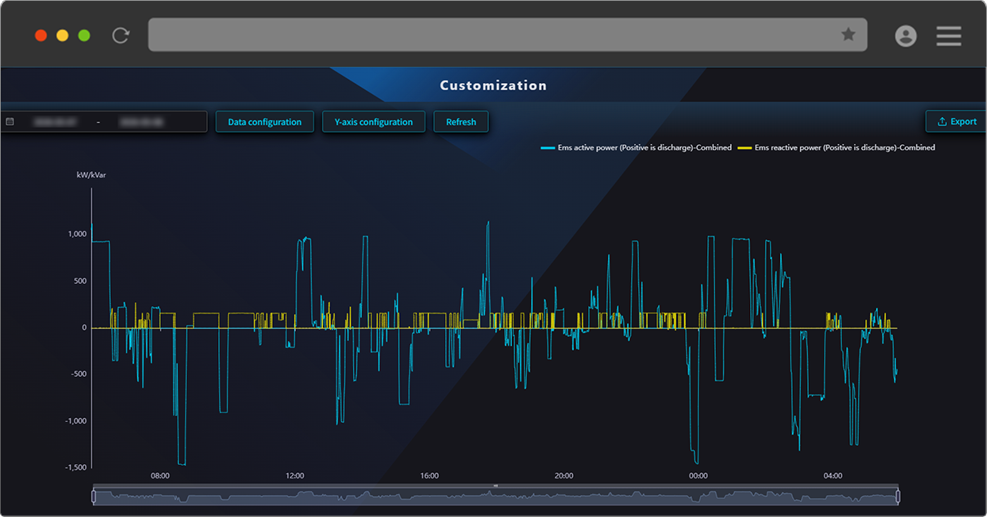
That’s where a BESS came into being. A BESS can support frequency regulation by injecting active power when grid frequency drops and absorbing active power when frequency rises, helping restore balance in real time.
At WHES, our utility-scale BESS solutions and WHES OS EMS are engineered to deliver high-speed frequency regulation for modern grids with high renewable penetration. With response times below 500 ms, the system can rapidly inject or absorb active power to stabilize grid frequency during sudden generation or load fluctuations.
The platform supports a wide range of ancillary service applications, including Frequency Control Ancillary Services (FCAS), Fast Frequency Response (FFR), and Frequency Containment Reserve (FCR), helping grid operators maintain system stability and comply with increasingly stringent grid code requirements.
WHES OS EMS also enables intelligent dispatch optimization and native integration with more than 50 third-party EMS and SCADA platforms across Europe, simplifying participation in ancillary service markets and multi-asset energy management environments.
Reactive Power Control/Voltage Control
Reactive power is the component of AC power that supports magnetic and electric fields rather than doing useful work. In simple terms, it is the power needed to support voltage and keep electric current flowing.
Insufficient reactive power can drive voltage down, increase equipment stress and losses, and in extreme cases trigger cascading voltage collapse across a wider area. In the August 2003 North American blackout, a shortage of reactive power was considered a significant contributing factor, and the event affected more than 50 million people.
A modern BESS can independently inject or absorb reactive power through its power conversion system, regardless of whether it is actively charging or discharging active power. This capability works even when the battery is idle, helping support voltage and improve grid stability.
At WHES, the PA-3.0EU utility BESS supports a full power factor range from -1 to +1, enabling dynamic reactive power injection and absorption for advanced voltage regulation applications.
Through its high-performance PCS architecture, the system can provide continuous voltage support independently of active power charging or discharging status, helping stabilize weak grids and renewable-heavy networks.
The PA-3.0EU utility system is designed to support utility-scale grid services such as Volt-VAR control, power factor correction, and reactive power compensation, while meeting demanding European grid code requirements.
Combined with low harmonic distortion (<3% THDi) and fast converter response characteristics, the PA-3.0EU helps improve overall power quality, reduce equipment stress, and enhance grid reliability in both transmission and distribution-level applications.

Black Start Capability
In the event of a total or partial grid collapse, most power plants cannot restart on their own because they require electricity to run auxiliary equipment like cooling pumps, fans, and control systems.
Black start capability is the ability of a power-generating unit or facility to restart and begin delivering electricity to a de-energized grid without relying on an external power supply.
A BESS with black start capability acts as a “jump starter.” It can energize transmission lines, provide the stable voltage and frequency reference needed to synchronize other generators, and support the sequential restoration of the network.
Congestion Management
Transmission congestion occurs when power flows exceed the physical capacity of a line or substation, forcing operators to curtail generation on one side of a bottleneck while dispatching more expensive resources on the other.
A BESS positioned at or near a congestion point can absorb excess power during high-flow periods and release it when conditions ease, effectively acting as a buffer that defers or avoids costly network reinforcement.
Loss Compensation
Every watt transmitted across a line incurs resistive losses. In large interconnected grids, these aggregate losses represent a meaningful share of total generation output.
A BESS positioned strategically within the network can reduce transmission and distribution losses. It supplies local demands and thus reduces the volume of energy that must flow over long distances and the associated I²R losses. It can also reduce losses by charging during low-loss off-peak periods and discharging during high-loss peak periods.
For network operators, this service helps them meet power quality and loss factoring obligations under grid codes.
Conclusion
A BESS is not a single-use asset. With the right configuration and an intelligent EMS, a BESS can provide frequency regulation, reactive power control, black start, congestion management, loss compensation, and other BESS ancillary services. For grid operators building the next generation of power infrastructure, a well-specified BESS backed by a capable EMS platform, like WHES OS EMS, is a foundational requirement.