
Blog
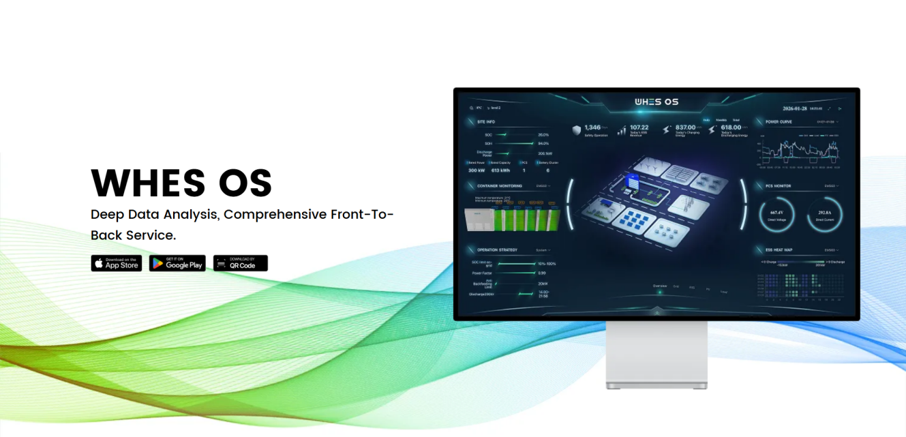
WHES OS 2.0: An AI Agent-Powered Smart Energy Management Platform
Electricity price volatility, uncertain solar output, and stricter cost targets have made enterprise energy management more complex. For factories, commercial parks, and other energy-intensive sites, an energy strategy needs to respond to both power conditions and business priorities.
However, traditional energy management systems often depend on preset rules and manual configuration. This may support basic automation, but it can limit the system’s response to real business changes, such as urgent production orders, sudden load shifts, or short-term electricity price opportunities.
WHES OS 2.0 EMS addresses this challenge with a self-developed AI engine and an AI Agent that can recognize user intent. Instead of relying only on fixed instructions, the system can understand business needs from natural language and turn them into executable energy strategies. This helps enterprises connect daily operations with smarter energy control.
How WHES OS 2.0 EMS Enables Smarter Energy Decisions
WHES OS 2.0 EMS is designed to move energy management from rule-based automation toward AI-assisted decision support. Its value comes from three core capabilities: intent recognition and reconstruction, automatic goal configuration, and flexible priority adjustment.
Core Capability 1: Intent Recognition and Reconstruction
WHES OS 2.0 EMS can identify business goals and energy needs from natural language.
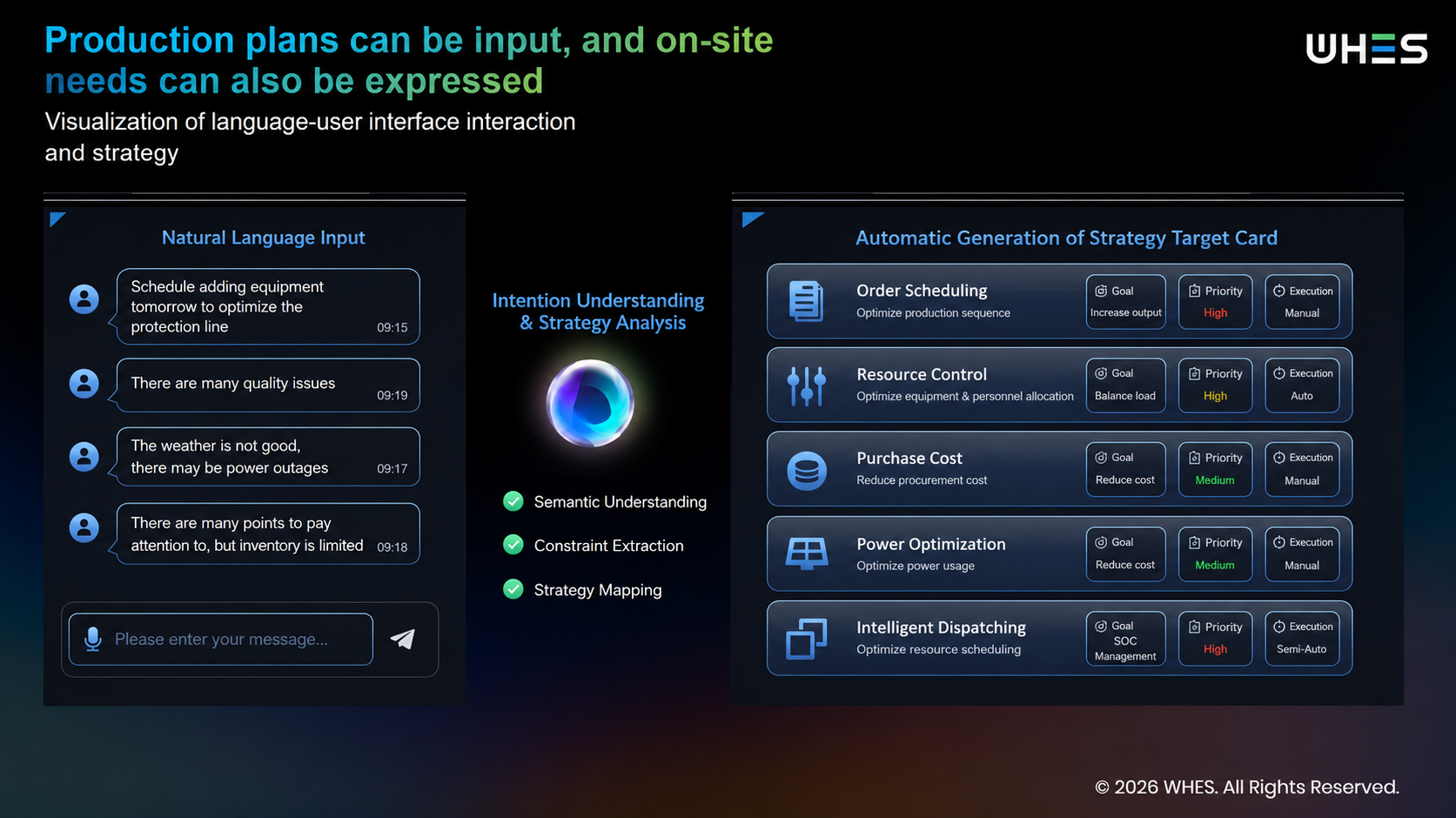
A user can simply type, “There is an urgent order tomorrow. Prioritize power supply for the production line.” WHES OS 2.0 EMS would then identify the core objective as production power assurance and translate it into specific control rules. For example, the system may reserve a higher battery SOC before the production period, reduce non-essential discharge for price arbitrage, and set a safety margin to handle possible load fluctuations.
In this process, the user does not need to manually configure complex parameters. A user can just tell the system what is needed, and the system can create a suitable energy strategy.
This capability is useful for many common enterprise scenarios, such as production power assurance, demand control, solar self-consumption, electricity cost reduction, and energy storage revenue optimization.
Core Capability 2: Automatic Goal Configuration
WHES OS 2.0 EMS can integrate data sources such as MES orders, load forecasts, electricity price changes, battery SOC status, and solar generation forecasts.
Based on these inputs, WHES OS 2.0 EMS can automatically create multi-dimensional strategy target cards, enabling users to prioritize objectives according to their needs.
For example, if electricity prices are expected to rise, the system can prepare a cost-saving strategy while still respecting SOC safety limits and power supply needs.
This helps enterprises make energy management more aligned with real operational priorities.
Core Capability 3: Flexible Priority Adjustment
Enterprise energy goals may change from day to day. Some days require a stable power supply for key orders. Other days may focus more on lower electricity costs, demand control, or green energy use.
WHES OS 2.0 EMS allows users to easily adjust the weight of different strategy goals based on real needs. After users adjust these priorities, the system calculates an optimal solution in real time.
For sites with solar power, energy storage, and variable loads, this flexibility can be especially valuable. The system can respond to sudden solar output drops, load changes, and price fluctuations with a more adaptive control strategy.
What Results Can Businesses Expect?
WHES OS 2.0 EMS is designed to turn AI capability into measurable business value, reflected in its closed-loop intelligence and measured revenue improvement.
1.Closed-Loop Intelligence
One common concern with AI-based energy management is the black-box problem. Users may see the system’s decision, but they may not understand why the decision was made.
WHES OS 2.0 EMS addresses this issue with AI strategy explanation and attribution replay. The system can explain why a specific dispatch decision was made.
For example, a user may ask, “Why didn’t the system discharge for arbitrage before the event?” WHES OS 2.0 EMS can provide a clear explanation based on load forecasts, SOC safety limits, and power supply stability needs.
A possible explanation may be: “To keep a safe SOC level and protect power stability, the system reserved energy and gave up part of the arbitrage benefit.”
This type of explanation helps users understand the logic behind each AI decision. It also makes the energy strategy easier to review, verify, and improve over time.
In addition, WHES OS 2.0 EMS supports AI device inspection and cloud digital twin technology. The system can analyze equipment status in real time, identify potential risks earlier, and support expert-level remote diagnosis.
This shifts operation and maintenance from passive response to active prevention. According to project estimates, more than 80% of common issues can be resolved remotely. This can help reduce downtime, shorten repair cycles, and lower operation and maintenance costs.
2.Measured Revenue Improvement
Field data show that projects equipped with the WHES OS AI intelligent dispatch engine can achieve an 8% to 15% revenue improvement.
The improvement comes from the system’s ability to capture electricity price windows, optimize charge and discharge strategies, and coordinate solar power, battery storage, load demand, and SOC safety limits.
Compared with traditional manual adjustment, AI-assisted dispatch can respond faster to price changes and site conditions. It can also mitigate the risk of missed opportunities, such as low-price charge periods or high-price discharge windows.
At the same time, WHES OS 2.0 EMS does not focus only on revenue. It also aims to protect power supply stability, improve production assurance, support green energy use, and reduce energy waste.
For businesses, this means AI is not just a technical feature. It becomes a practical tool for lower energy costs, better energy storage utilization, stronger operational resilience, and more predictable returns.
Conclusion
WHES OS 2.0 EMS helps businesses turn natural-language needs into executable energy strategies. With intent recognition, automatic goal configuration, flexible priority adjustment, AI strategy explanation, and remote device diagnosis, the system provides a more intelligent way to manage enterprise energy assets.
For companies that face electricity price volatility, solar output uncertainty, and strict operational requirements, WHES OS 2.0 EMS offers a practical path to reduce energy costs and improve project revenue.
At WHES, our energy storage systems are equipped with WHES OS EMS. We also provide open integration capabilities for other energy systems. Contact our team to learn how WHES OS 2.0 EMS can support your project and help you unlock greater energy value.